Thursday, 31 August 2017

Refashioning project: creative solutions for pretty but unwearable impulse purchases

Have you ever bought an item of clothing, thrown it on in the changing room and decided it looked good, or scooped it up as an impulse buy, only to get it home and realise there is something about the fit that makes it almost unwearable? With high street shops under pressure to bring out new 'micro-collections' every couple of weeks, it's not surprising some garments slip through the cracks (these are usually the ones you'll see en masse on a sale rail) but it is frustrating when there is something you really like about the piece of clothing you've just bought.


My sister snagged two of these maxi dresses, one for each of us in slightly different colours, at a sample sale. I loved the printed silk and was sure it would be great to wear on holidays, but soon realised while wearing it around the house on a hot day that although there was plenty of fabric gathered into the waistband of the skirt, the bottom was so narrow that I couldn't walk normally! At first I wondered whether the skirt had somehow ended up upside down during the manufacturing process, but it had pockets in the side seams, so the narrow skirt was either deliberate, or no-one had tried walking about in it during a fitting. 


The simple solution would have been to make a slit in one of the side seams (or take it to a charity shop!) but I was feeling adventurous; I really liked the fabric and the print, the top was super cute and it had pockets, so out of curiosity I unpicked the waist seam and laid a simple pyjama trouser block onto the skirt to see if I would have enough fabric to make the dress into a jumpsuit. There was just enough, so using the existing side seams with the pockets as outside leg seams I cut two 'legs' from the skirt, adding an extra couple of inches above the waist so I would be able to move about! After sewing up the legs to make a pair of loose trousers, I re-attached the waist of the trousers to the top and added shoulder straps made from the leftover fabric. 
Although it ended up being quite a different garment, I've got a fab summery outfit to wear on holidays or for lounging around, and not only is it comfortable to move around in, but it has pockets


This sort of 'refashioning' project may seem daunting but it's a worthwhile thing to learn; being able to see the potential in a garment and making some alterations so that it's something you love wearing rather than something you tolerate is such a useful skill. A few hours spent learning how to use a sewing machine and making a simple garment from scratch should give you the confidence to fix the clothes in your wardrobe that are bothering you. If you're not sure about giving it a go unsupervised, try beginners sewing classes at somewhere like The Thrifty Stitcher , where sewing pro Claire-Louise Hardie also runs alterations workshops and troubleshooting sessions for personal projects. 

I still have the second dress languishing in my wardrobe and I’m planning another refashioning project so it will be ready for next summer: watch this space!


Thursday, 24 August 2017

Twine @ Twilight at Chelsea Physic Garden: the history and future of plant based fabrics

Last Thursday, the 17th August, I went to Chelsea Physic Garden for their 'Twine @ Twilight' event, celebrating our relationship with textiles from the natural world. 


It was a beautiful warm evening, and after picking up my complimentary cocktail I wandered through the gardens, enjoying the exuberance of a carefully planted garden in high summer. The borders were such an artistic combination of colours and textures, so I loved finding a textile installation that mirrored this: Dr Jane Scott's textile sculpture suspended over one of the paths like part of the canopy of trees.


The Weaves and Leaves exhibition took the form of laundry day in the History Garden: swatches or sheets of fabric (alongside the the occasional vest and pair of socks) were pegged out near the plant they were produced from. It was a visually pleasing and tactile illustration of the versatility of these plants, comparing the varieties of cloth that can be woven from bamboo, cotton and hemp. The notice boards in the garden explained the history of our relationship to these plants, emphasising how reliant we have always been on the natural world for clothes and textiles, but also pointing out the ways in which the industrial farming of plants such as cotton has negatively impacted people and the planet. From the start of the Industrial Revolution, where businessmen in the UK profited from cotton picked by slaves in the US, to the harmful impact that modern industrial cotton farming, which relies heavily on pesticides, has had on farmers, their local communities and the environment. The exhibit invited us to ponder the future of the natural textile industry, and consider which plants could yield the greatest benefit for workers, consumers and the natural world. 


Sustainable fabric supplier Offset Warehouse were hosting a brooch making workshop, so feeling inspired by their selection of ethically produced silks and jerseys (if anyone you know is still convinced that sustainable fabrics aren't fashion-forward, a quick glance at Offset Warehouse's website is guaranteed change their minds!), the gardens outside, and their helpful set of embroidery instructions, I rustled up a brooch to go with my outfit!  It was a relaxing way to spend half an hour, even if I did have to rush off at the end to get to Kate Poland’s talk: “Spinsters, Hecklers and Lingerie”, about the history of linen.


Attendees at the talk were given bingo cards, to help us spot words which have their origins in the growing of flax and the production of linen, which dates back thousands of years, and is the earliest known woven textile. As well as wonderful words I had never heard before, like "scutching" (the removal of the 'straw' that surrounds the soft fibres in the flax stems), I also discovered the origins of more recognisable words. The Romans used linen for garments worn under thicker outer clothes when in colder parts of Northern Europe, giving us the word "lingerie", “heckling” referred to the combing of flax fibres ready for spinning, and "spinster" originally referred to a woman who could make her own living, usually through the spinning of flax into linen (time to reclaim that word, I think!). Linen has been such a widely used fabric because it has desirable properties; flax is easy and quick to grow in temperate climates (only 90 days from sowing to harvesting), and linen as a fabric can be spun and woven into different weights of cloth, and is moisture-wicking and moth-resistant. Because some types of woven linen could be difficult to maintain, requiring careful storage and ironing to avoid creases, it declined in popularity during the 20th century as easy-care man-made fabrics became popular.


In 2014 The Flax Project took on a challenge to produce a linen garment from scratch within London; growing flax at community farms and allotments, and encouraging the involvement of groups of children from local schools, it took a year and involved almost 500 people! The resulting hand-knitted garment gives an interesting insight into the complicated process involved in making our clothes that we rarely think about, and is a true example of slow fashion.


 The European Consortium of Hemp and Linen were also on hand with a swatch book demonstrating the resurgence of linen as the fabric we all need in our modern wardrobes; knitted as a jersey it is soft with a good drape but not too stretchy, and it can also be woven or felted to create smart suiting fabrics. The samples banished bad memories of crumpled summer trousers; linen has re-emerged as a fabric I would be keen to work with again.


Another fabric I am newly fascinated by is Pinatex, a leather substitute made from pineapple fibre. The fibres come from the plant rather than the fruit itself, and the non-woven unfinished fabric feels rather like a thick felted wool, or a millinery 'hood' before it is blocked into a hat. After the fabric is treated it is usually used for accessories or footwear, like my fab Po-Zu shoes! Pinatex feels really light so it's great for summer shoes, but it's also flexible so it wears well. The range of natural, bold colour or metallic finishes means it looks like a fabric of the future and should appeal to even the most hi-tech fashion lovers.


There were also cyanotype printing workshops with Zoe Burt and flower-crown making workshops with Pip Bensley Flowers that I sadly didn't have time to attend, but looking at examples of people's handiwork as they walked around the gardens, these artists were also doing an excellent job of emphasising the beauty of the natural world, and how it can inspire and delight us. I thought this was a great event; part history lesson, part peek into the future, encouraging a celebration of the beauty around us while gently pointing out the ways we can make the world more beautiful through thoughtful actions.


Monday, 21 August 2017

Upcycling project: wedding accessories

I’m trying to make the most of my wardrobe, re-using or upcycling the things I’m not making the most of, so I thought I’d share the results on my blog over the next few months, starting with some last-minute accessories for my weekend as bridesmaid at my sister’s beautiful wedding! 


Having spent a fair percentage of my free time in the first six months of 2017 making a wedding dress for my sister, I hadn't put a lot of thought into what I was going to wear for her two wedding days (one at a registry office in Lewes, the other at an idyllic-looking farm, complete with wildflower meadows and woodland glade) in East Sussex. I ended up being a proud outfit repeater at both events, wearing a Whistles dress I had originally bought for a friend's wedding in 2011 to the registry office, and walking my sister down the aisle and into the woods in a re-worked dress I had made and worn to another friend's wedding in 2015. Since there was no guest overlap (apart from me!) from the other weddings, and I'd just been a guest so there weren't a whole heap of formal portraits documenting my appearance, I felt justified in wearing both dresses again, particularly as I had worked especially hard on the handmade dress when I first made it. Fortuitously, it also fitted perfectly with the colour scheme of the wedding party, and there was some sentimental significance to one of the fabrics I had used; a piece of eau-de-nil beaded chiffon that I had saved after using most of it to make a dress for my sister for her Sixth Form Leavers Ball, over a decade ago. 


I'm a real hoarder of fabrics and haberdashery, even bits and pieces that don't have sentimental value, and since I'm trying to downsize and lead a slightly less clutter-filled existence, my first port of call had to be the pile of pretty things I'd bought that were just waiting for the right occasion, and the pile of rarely-worn clothes and accessories that aren't looking their best and could do with some creative repair. 


I bought these velvet leaves from Brixton vintage treasure trove Leftovers several years ago, but had never really decided what to do with them. Since no good wedding is complete without a hat, or at least a fancy fascinator, I decided to use the leaves to make a mini version of a 1940s 'calot' hat; a brimless hat that sits on the back of the head. It would sit between my mini undercut and my pinned-up hair, hopefully hiding the messy bits of my 'do! 


I used several layers of cotton bobbinet (offcuts from a layer of my sister's wedding dress skirt) to create the base, tacked together then pasted with a mix of PVA glue and water and pinned to a polystyrene head to dry! I sewed each leaf on individually, then used some felt as a lining. The final touch was to add some small thread loops on the inside so I could pin it securely to my head. Although I was worried that I might have needed a hat pin as well, the bobby pins worked their magic and the hat stayed firmly in place, even on a day so windy that I arrived at the venue in an old-fashioned headscarf arrangement so my hair wouldn't get ruined! 


One of my bridesmaid duties was to look after my sister's possessions so she wouldn't need a bag, so I needed a decent handbag that could hold two lots of make-up, an umbrella, sunglasses, phones and the notebook I'd written my maid of honour speech in! I had a white chainmail handbag that I'd bought in a thrift store in Wellington, New Zealand, but it was looking a little worse for wear as several of the links had come loose. I also happened to have a large collection of beads and broken jewellery, so I started off embellishing the bag with a couple of broken brooches.


 The first brooch I added, a cluster of diamanté and pearls, worked so well that I abandoned the other brooches and used pearls from some broken necklaces to adorn the rest of the bag. The abstract design was informed by the missing chainmail links and the number of beads available, but I was really pleased with the final result; this bag will be coming with me to any fancy functions I attend in the future! 


Wednesday, 16 August 2017

'Balenciaga: Shaping Fashion' and 'The World Of Anna Sui': can couture cure us of our fixation with fast fashion?


Lots of fashion writers have predicted  the death of couture, as pressure grows on designers to produce more and more collections per year, trends appear on the high street within weeks of catwalk shows at a fraction of the price, and, if you are a public figure, being seen in an outfit more than once will be remarked on at the very least, if not ridiculed. 


The popularity of couture as an exhibition subject, however, seems to go from strength to strength. I visited Balenciaga: Shaping Fashion at the V&A and The World Of Anna Sui at the Fashion and Textile Museum, and although neither exhibition tops the superstar status of the Alexander McQueen retrospective (when the V&A stayed open through the night to meet demand for tickets in the final few days), the popularity of fashion exhibitions suggests we haven't completed the transition from seeing fashion as valuable to seeing it as disposable. Both exhibitions illustrate something important about couture that we need to embrace again in order to create a more sustainable fashion industry. 


The World of Anna Sui showcases a designer with boundless enthusiasm for fashion; someone who is constantly intrigued and inspired by the world around her and has pursued her dream of being a fashion designer from early childhood. Her maximalist creations, a mash-up of pop culture references, bold colours and striking fabrics, are the stuff of my teenage dreams, but her painstaking research into fashion history and her beautifully constructed takes on vintage styles held a particular appeal for my inner costume geek. I was swooning over her 40s tea dresses, which feature Christian Berard prints on jewel-coloured silks and fondly reminiscing about my attempts to recreate her 'pastel grunge' looks with retro finds from Brighton's thrift shops in the mid 90s. 
Her brand is centred around looks that are eye-catching and unique, optimistic and playful. Fashion is presented as something exciting, the clash of prints and textures showing a disregard for traditional 'rules' of dressing that echoes the rebelliousness of the subcultures that Sui references in her designs. 


There is much more regard for tradition at the V&A's Balenciaga exhibition, which is a celebration of the craft of couture, and of Balenciaga as a master cutter and fitter as much as a designer. The exhibition emphasises the importance of the choice of fabric in determining the drape and hang of a garment, and showcases the virtuoso pattern cutting which is central to the deceptively simple shapes of Balenciaga's outerwear. X-rays, reconstructions of garments in toile form and even a dress displayed on a mannequin inside out reveal the intricate inner structure of evening gowns, the boning and underpinnings necessary to create the perfect silhouette. I was impressed by the proliferation of pockets, even in an elaborate evening cape, and reflected on it over on my Twitter account, where the lack of decent pockets in women's clothing is lamented and ridiculed on a regular basis. 


As well as the garments themselves, there were also films showing the process of creating couture: mesmerising clips of the craftspeople at Lesage embellishing fabric with embroidery and sequins, as well as a short documentary showing the stages of cutting, fitting and finishing a made-to-measure jacket. As a dressmaker myself, I always appreciate being given an opportunity to see my fellow makers in the spotlight, as I hope it reminds people of the human labour that goes into the production of clothes. We are all garment workers, in the end, it's just that some of us have been fortunate enough to be given the time and opportunity to develop and perfect our craft, to have our work appreciated and to earn a decent salary. 


Obviously couture is elitist, and outfitting ourselves in made-to-measure luxury for everyday life isn’t a practical option, but even clothes that highlight wealth inequality can be viewed as part of a more complex story about the wider fashion industry. Today, the industry’s biggest problems are exploitation, both of people and the environment, through overproduction and overconsumption. People struggling to make ends meet are not going to be overconsuming, but those of us who can afford to splash out on a new outfit when the fancy takes us need to think about what we really value about fashion, and act accordingly. I spent hours at the two exhibitions (and the cost of at least one fast fashion outfit on tickets), and I was delighted by the creativity and craftsmanship I saw, and it reaffirmed that I want my own wardrobe to look like this, as much as possible, rather than the bland and uninspiring fast fashion that has turned me off high street shopping.


There is a possibility that the tide could be turning; earlier this year Stylist Magazine published this article about mental health and burn-out in the upper echelons of the fashion industry. Several designers, including Jean Paul Gaultier, now only produce couture, having found that the pressure to produce an ever-increasing number of collections sapped them of energy and inspiration. For those of us who need more affordable fashion options, many small ethical and sustainable clothing brands have also rejected the high street's emphasis on constantly changing stock, opting instead to sell multi-seasonal pieces that will be versatile enough for even the most carefully curated of capsule wardrobes. The ongoing popularity of good quality vintage clothes also suggest that people are nostalgic for more than cute floral prints, they also still value flattering fit and appreciate clothing that is made to last.

These two exhibitions are a must for fashion fans, but it might be worth taking along a friend who can't understand what the fuss is about. Being encouraged to see fashion as an art form might prompt more thoughtful shopping habits, or a new respect for the people who make our clothes, and this has got to be a good thing.

Wednesday, 9 August 2017

Festival fashion: find the weekend's worth of amazing outfits lurking in your wardrobe!

If you’re a festival-goer in the UK, you know the drill: it’s either going to be rainy and muddy or hot and dusty (or if you’re really lucky, both!), your clothes are going to be crammed into a rucksack and thrown around a tent in the dark,  you’ve got limited access to mirrors but everyone’s going to be taking loads of photos. I love dressing up for festivals, but I’m sceptical of what’s often advertised as festival fashion on the high street (the combination of playsuit and portaloo is a no-go for me, I’m afraid), so I always see festivals as a chance to give some of my unloved clothes their day in the sun rather than investing in a new selection of impractical outfits.

Festival classics:
There’s a reason why stylish-but-practical jackets, denim cut offs, wellies and chunky socks will always be festival staples; you’re ready for everything the weather might throw at you, and as my sister is proving here, you’re always camera-ready even when you are holding a broken long-drop door for a pal!


Clothes that are Too Much for the real world:
Festivals are a time to escape from day-to-day life and immerse yourself in the atmosphere that the organisers have created. There are no dress codes, so you can proudly wear clothes that might be hiding in your wardrobe because you feel they are too short, too low cut, too revealing for every day. I used to wear this dress a lot, then got a bit body-conscious, but I felt it was perfect to wear at Latitude to watch Sh*t Theatre’s show about Dolly Parton!


Fancy Dress:
Whether the festival you are attending has a theme or not, we all have clothes we’ve bought for fancy dress parties that we can re-purpose as perfect festival wear. My sister had a white lace mini dress from a 60s theme party that we persuaded her to wear for the day as the bride-to-be for her festival-based hen do, and the high-street rucksack ended up being more than a novelty festival purchase, she's now a backpack aficionado!


Grab an on-site bargain:
While each year has its festival-fashion cliche, and there will be no shortage of stalls selling those things if you want them, vintage stalls and pop-up charity shops offer festival bargains that you’ll still want to wear long after you’ve finally stopped finding glitter everywhere. A couple of years ago I found a red pleated maxi-skirt in a pop-up vintage shop at Folk by the Oak which has become a wardrobe staple, and this year the Oxfam shop at Latitude had a fantastic selection of clothes, including a brand new Ted Baker coatigan which kept me cosy at the festival and will slot perfectly into my work wardrobe.


Find your own festival style:
We all have clothes we’ve bought for a certain event and haven’t been sure how to incorporate into our day-to-day wardrobes, or old clothes which are comfy but not eye-catching, so why not try mixing and matching some of these to create fabulous festival outfits? Christmas party tops paired with faded shorts, or a vintage dress worn with an old hoodie, beach-holiday sundresses with a cardi and leggings for a chilly evening, you’re bound to find something that suits the festival and your style.

Respect the festival site, respect your clothes, take them home with you!
Most festivals are getting much better at providing recycling facilities, re-usable cups and places to refill water bottles, but you can avoid adding to landfill at the end of a festival by packing up everything you came with, including your clothes, and taking them away with you! If you decide you can’t bear festivals and you’ll never have need of your festival-specific clothes again, wash them and take them to a charity shop, but it might be better to hang on to them; who knows when you might next need a sparkly Grecian muslin dress, or a glittery mermaid tail...


Sunday, 30 July 2017

Shortcut to Sustainable Fashion: Post-Couture Collective at V&A Friday Late

On Friday evening I went to the V&A for July’s Friday Late event. The theme was Hack. Make. Create and I went to listen to Martijn van Strien from the Post-Couture Collective talk about his vision for the future of sustainable fashion. The talk was held in a corner of the Fashion gallery, where the lighting was a little moody, so please excuse the rather grainy photos, the Post-Couture Collection website has a far better collection of images of their work. I wanted to write up and share what I learned at the talk because I was impressed by this novel approach to sustainable fashion, and how quickly the initial idea is evolving and maturing.


Martijn van Strien trained as a textile designer, learning about how ‘messed up’ the fashion industry is firsthand. After working for a Dutch company that were taking a more ‘traditional’ approach to sustainable fashion (a traceable production line, smaller production runs etc), he was inspired by the Maker Movement to imagine how the fashion industry could create less waste if production was moved from large-scale specialised factories to small-scale, local facilities that can be used to create a variety of products. These facilities would contain laser cutters and 3-D printers, and like the ‘hack-spaces’ that are popping up in various cities, would work on an open-source model.


To eliminate over-production, exploitation and waste in the fashion industry, the Post-Couture Collective’s clothes are designed to only be produced as required. The consumer buys the pattern as a digital file for a small fee (van Strien was enthusiastic about the open-source model but doesn’t believe that everything should be free - “I need to eat!” he explained, and €5 for a dress pattern doesn’t seem extortionate), they can then adapt the pattern to their own measurements using Illustrator or similar software, before buying their fabric and heading to their nearest Maker Space to have their garment laser cut. The garment is then assembled with no need for a sewing machine or other tools, using the ‘connectors’ - a series of barbed tabs and slits along the seams of each garment piece. 


Van Strien was quick to point out that he trained as a textile designer, not a fashion designer, and that his first collection of six pieces used simple, ‘archetypal’ shapes and straight seam lines as his main concern was developing and perfecting the connectors that formed the assembly method of the garment; the crucial aspect of this radical new approach to garment manufacture. The first collection was made from ‘Spacer’ fabric, a knitted, breathable fabric made from post-consumer plastic waste. Although usually a fan of monochrome, van Strien included a pale green in his collection as the fabric’s unusual colour was a result of being made from Sprite bottles! The connectors add a simple but interesting visual element to t-shirts and shift dresses. 

He acknowledged the limitations to this production method: customers needed a good working knowledge of the appropriate software to really be able to customise the design to their exact requirements, as well as access to a laser cutter. He had a bold vision for the future of the Post-Couture Collective: a ‘Maker Shop’ where customers could select their design, have it digitally altered to their exact requirements on-site, choose their fabric and have the garment pieces cut for them using the in-house laser cutters, all within the space of around half an hour. The customer would then take away their garment-assembly kit, which should take a further half an hour to make up. Hopefully, this process would be quick enough to satisfy customers desperate for a fashion fix, but seeing each part of the process, and being responsible for a key element of it, would encourage consumers to value and take care of their garments.


Van Strien also emphasised the limitations of the designs in his first collection and how he was improving his design process. As well as inviting feedback and constructive criticism from customers, he has worked with recent fashion design graduates who have challenged him to develop the technology to produce more complex pattern pieces. For him, the advantage of open source design is that development happens faster as more people experiment with and improve on designs. He is also interested in improving accessibility for people without the requisite software knowledge, and jokingly put out a call for programmers to work alongside him in creating more user-friendly pattern-drafting software! 


As with any technology still in its infancy, basic prototypes often seem a long way off challenging traditional methods of production or consumption. The first collection was interesting, the simple shapes reminiscent of Pierre Cardin’s or Andre Courreges’ 1960s space-race- inspired collections, but the sort of thing a fashion or technology nerd might buy as a novelty, not something that would become a wardrobe staple. What impressed me was the huge leap forward in style and wearability shown in the second collection; these were pieces that were futuristic but in a wearable, sophisticated way, not in a kitschy, sci-fi costume way. Don’t get me wrong, I love a kitschy sci-fi costume, but the only thing that is going to make sustainable fashion innovations take off is if people can imagine wearing them right now, and I can definitely see pieces from the Post-Couture Antwerp Collection finding a home in my wardrobe. I won’t be giving up my sewing machine just yet, but I might just be looking for a hack-space with a laser cutter in my neck of the woods!

Wednesday, 28 June 2017

This summer's must-have accessory? Kindness.

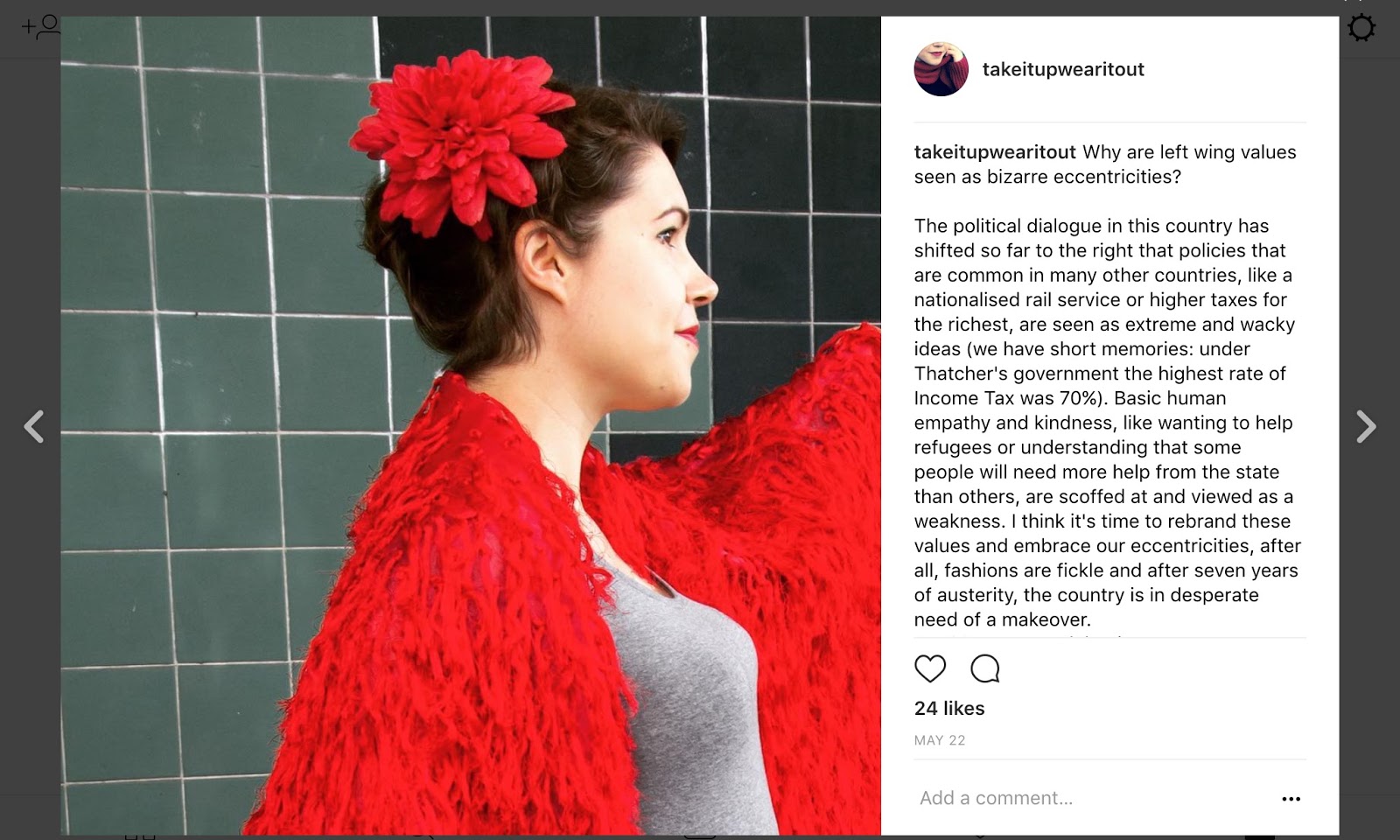
The last twelve months have been pretty grim if, like me, you're emotionally invested in creating a fairer, more equal society. In 2016 the EU referendum was fought on a platform of fear and lies, and left an angry, confused and divided nation in its wake. The hate stirred up by the tabloid press and fuelled by professional contrarians has resulted in violence and murder, so when another general election was called I felt like I needed to do something, anything, to counter the hysterical and vitriolic coverage of the election campaign in the press. I 'cosplayed' the election again, sharing my outfit posts (complete with calm and rational political commentary!) with friends on social media in an attempt to give people some more positive, cheerful content to enjoy. 

Unsurprisingly, my posts didn't go far beyond my circle of friends and mutual followers (pleas for considered and thoughtful action just don't have the click-bait appeal of hate-speech) and seeing the horrifying abuse that other people who have encouraged a kind and hopeful approach to politics have received, I'm kind of glad they didn't. But they did make me feel better, as they forced me to focus on the positive rather than the negative, so I wanted to take this feeling forward into how I engage with media content in the long term, rather than just in regard to election coverage.


As well as trying to encourage fear and distrust of one another, we're also encouraged to feel bad about ourselves, and publicly shame or ridicule anyone who isn't following an archaic, classist, discriminatory and seemingly endless list of 'rules' designed to police our appearance. I'd love to live in a world where I could breezily tweet "just wear what you want!" as temperatures soar and we peer into our wardrobes trying to figure out if we have anything, anything at all, that is 'suitable' for whatever we might need to do in weather we're just not used to. But we don't live in this kind of utopian future (yet!) and I'd be doing a disservice to a lot of people if I pretended that we are all subject to equal levels of judgement and condemnation. By moaning about my personal pet peeve (the ongoing policing of the upper arms of all women over 30), I'm belittling the constant public scrutiny other people face over every aspect of their appearance; it's false equivalency. "Wear what you want" doesn't require a daily act of courage from me, a rejection of years of social conditioning, the strength to face media-sanctioned cruelty from strangers. So I'm not going to demand bravery from activists who have been doing it for years, or from people whose bodies and clothing choices are none of my business, but I am going to demand an act of kindness from everyone else. 


We've been brainwashed by countless "circle of shame" or "worst dressed" photos to have similarly uncharitable thoughts about the people around us; people who dare to defy clothing conventions; who dare to (in the words of pearl-clutching tabloids) 'flaunt their assets'. Maybe we need to unpack why we leap to conclusions about folk who just want to go about their day feeling fabulous about themselves. Are we jealous of their apparent fearlessness, angry that they've decided that the rules don't apply to them when we've been trying so hard to follow the rules so closely, and are still told that we're found wanting? Whenever we criticise someone else for being "overdressed" or "not making an effort", for revealing or concealing too much of themselves, we're not just policing their bodies but also our own. We're restricting everyone's freedom of self-expression, but most vital of all we're restricting everyone's ability to feel comfortable in their own skin and just move through the world without attracting unwanted commentary. 


The acts of kindness I want to see involve, at the most basic level, doing nothing. If you don't approve of someone's appearance - who cares? Keep it to yourself! There's a wealth of old adages that can apply to this situation, and with good reason; petty meanness has never been a good look on anyone. Compliment pals who are rocking great outfits instead.

Hopefully this will already be second nature to you, and you might feel emboldened to gently challenge body shaming if you hear it from friends or family, and ignore it when you see it presented as a click-bait headline. As Labour's general election campaign showed, it's possible to challenge the status quo in quite a radical way and win people over to your cause if you do it in a thoughtful and positive way. I was so glad to see that there isn't an infinite appetite for cruelty, spite and deliberate misinformation. People have shown that they can be nuanced in their thinking, and that they are open to a kinder, fairer way of being. But rather than expecting other people to create this world for us, we have to push back, even in the smallest ways, against the relentless negativity we have been subjected to for far too long. Being bitchy is so last season, this summer should be all about kindness, and the joy (or, quite honestly, just quiet relief), that can bring into all our lives.