Showing posts with label environment. Show all posts

Wednesday, 22 April 2020

Fashion Revolution Week 2020: What's In My Clothes?

I’m surprised more horror stories aren’t written about clothing. Maybe because it looks so benign, hanging there in neat rows in a shop, arriving on your doorstep carefully wrapped, or sitting inert in your wardrobe. Or maybe it’s because we don’t like to scratch at fashion’s shiny facade. As well as horrifying tales of garment worker exploitation, there’s the environmental destruction to think about. After all, have you ever really considered what’s in your clothes?


We all think of cotton as a traditional, natural fibre. But cotton’s dark history of human exploitation and misery also started to include ecocide in the mid 20th century as DDT was sprayed onto cotton crops to kill the bollworm. Rachel Carson chronicled the devastating effect on wildlife in her book Silent Spring in the early 60s. Cotton is also an incredibly thirsty crop, and attempts to divert rivers to irrigate large cotton fields in Uzbekistan have transformed the Aral Sea, once the world’s largest inland sea and a thriving location for nature, fishing and tourism, into little more than a salty dust bowl.


A fact that really shocked me is the amount of water it takes to make one cotton garment, so much so that I had to emblazon it on one of my works of wearable art - 2700 Litres. On this shirt, every sequin represents one litre of water. That figure includes water for irrigating the cotton, processing the fibre, dyeing and finishing the garment, but that’s a lot of water. XR Hammersmith and Fulham also illustrated this beautifully during their Boycott Fashion event in Lyric Square - with nine rainbow-coloured bathtubs. Unfortunately I don’t have room for nine bathtubs in my hallway, so it had to be something small but visually arresting instead. 


Since clothes started to be mass produced in the mid 19th Century, we haven’t managed to do a great job of dyeing them safely. Fortunately we’ve stopped using arsenic as a green dye, but research carried out by Greenpeace as part of their Detox Fashion campaign, published in 2012, showed that brands were using azo dyes that contain cancer-causing carcinogens. Other tests revealed nonylphenol ethoxylates or NPEs in water systems, which are widely used in cleaning and dyeing processes. These chemical compounds are toxic to aquatic life, persist in the environment and biomagnify. Commercial fabric dyes contain mercury, cadmium and lead, and in many textile manufacturing areas around the world, the rivers running past dye houses and tanneries are the only source of water for drinking and washing for local people. 

Stories of dangerous dyes from days past inspired this horror-themed blog post a while back, and the creation of an arsenic-victim Halloween costume. But it’s a horror story that persists to this day and affects millions of people worldwide. 


Polyester clothing now accounts for over 60% of garments made worldwide. What many of the owners of those garments might not know is that polyester is made from plastic, a product of the petrochemical industry. The carbon footprint of a piece of polyester clothing is more than twice that of a similar piece of cotton clothing. And polyester clothing is also creating a global water crisis of its own - microfibre pollution.

When we think of plastic in our oceans, we might be thinking of the images we’ve seen in Blue Planet 2 - plastic bottles and containers bobbing about, bags or fishing lines caught around sea birds and turtles, or the scraps of broken-down plastic in an unfortunate fish’s stomach. But there is another hidden problem - the microfibres that are shed from synthetic garments every time we wash them. Too small to be trapped by filter systems in water treatment plants, they end up in the oceans where they add to the plasticky soup being consumed by sea creatures and eventually, us too.


Again, the figures are mind-boggling, as emblazoned on my second piece, 700,000 Fibres. Individually, these microfibres are far too small to see. But when you start to think of the amount of polyester clothing each of us owns and how often we wash those clothes, it starts to become a global problem. Research by Friends of the Earth has shown that 83% of water contains microplastics. That includes bottled water and drinking water as well as rivers and oceans.


I wish I could tell you that there is a quick fix for all these problems - a perfect fabric with no environmental impact, a magical dye that leaves no chemical residue but is colourfast and never fades. Unfortunately we live in a complicated, messy world and there are no quick fixes. Sustainability-minded manufacturers are gradually starting to switch to fabrics, dyes and processing that have less of an impact on the environment, but once again we need to keep asking the big brands to change. If we all ask #whatsinmyclothes we’ll hopefully end up in a situation where no one has to worry if they are drinking the residue from some freshly-dyed fabric, or scraps of the yoga pants they washed a while back.

Saturday, 22 June 2019

The Government won't fix fast fashion. Can consumers challenge a destructive industry instead?

It’s no secret that fast fashion is bad for people and the planet. From river systems polluted with toxic dyes and the exploitation of workers at home and overseas, to microfibres from the washing of polyester clothes ending up in the food chain and even the air we breathe, our addiction to cheap clothes is causing us serious harm. 


When the Environmental Audit Committee chaired by Mary Creagh MP published its findings after an in-depth investigation of the fashion industry, many of us hoped that the government would legislate in favour of the report’s recommendations, which included a ban on incinerating or landfilling unsold stock, mandatory environmental targets for large brands and tax incentives for recycling, repairing and responsible brands. 


To the dismay of most of my Twitter timeline on Tuesday morning, the government rejected even these mild regulations in favour of allowing the industry to self-regulate. This was particularly disappointing after recent reports that fast fashion brands are not implementing the changes they had promised to. The future of the Bangladesh Accord (which aims to secure safer workplaces in the wake of the Rana Plaza factory collapse) is also uncertain, so the chance of the industry properly regulating itself is as slim as a teenage catwalk model. 


Environmentalists and climate change activists are hugely concerned about the impact that fast fashion is having on our planet, but even if you’re a fast fashion fanatic you still have reason to be worried. In Elle Magazine’s 2018 Sustainability issue, Marie-Claire Daveau, head of sustainability at Kering, gave this stark warning: “if we don’t do this now, there will be nothing around to make fashion with in 20 years”. If that doesn’t make you quake in your boots, then I don’t know how to help you. If you truly love fashion, then you know it has to change.


So what can we do? As an individual consumer with limited spending power, it’s easy to feel powerless. But if we act together, we can hit the brands doing harm where it hurts - their profits. 


Extinction Rebellion have launched a Boycott Fashion action, where participants pledge to buy no new clothes for a year. If that sounds too daunting, the Collaction Slow Fashion Season has just started, and only lasts for three months.

Both actions make it clear that only brand new fast fashion is off the table. Participants can still buy secondhand and vintage clothes and swap clothes with friends or at a clothes swap. Mending, upcycling and making new clothes is encouraged; it’s a great way of breathing new life into old clothes, and understanding the skill and hard work that goes into garment making.


But what if you really, really, really have to buy something new? Most of us don’t urgently need new clothes, but we do urgently need to change our long-term shopping habits. Instead of panic-buying the first thing we see at the last minute, we can save money in the long run and experience more satisfaction with our purchases if we put a little thought into them. 


Look into ethical and sustainable brands (I’ll put up a post soon with some links in case you don’t know where to start looking) and interrogate your reasons for buying. Is your “need” genuine and urgent (I imagine some of you are dreaming up nightmare scenarios about secondhand underwear) or are you shopping because you are bored or unhappy? Could you get the same shopping “buzz” from having a wander round the charity shops in your local area or liking clothes on Depop and Vinted rather than filling your ASOS basket? 


If you rely on a high street fashion brand for a particular bra size, for example, or your kids school uniform, write to the brand and tell them that you are concerned about the negative impact they are having on the planet. Fashion Revolution have a template letter here if you’re unsure of what to say. 

Alternatively, you can write to your MP to express your disappointment with their rejection of the EAC’s recommendations. Fashion Roundtable has a template letter here.


We need to let fast fashion retailers and the government know that we will no longer accept business as usual. Fast fashion is a recent phenomenon (it barely existed when I was a teenager!) and like any unflattering trend, it has outstayed its welcome. Most of the 20th century’s iconic fashion trends were brought about by innovation and rebellion, so say no to the status quo and challenge yourself to become an icon of rebel style!

Thursday, 13 September 2018

The Festival of Natural Fibres

After a lovely mid-week mini-break at the Knepp Estate learning about rewilding, heading to the Festival of Natural Fibres at Craft Central felt like a good way to end a week of annual leave. Thinking about more sympathetic ways to use the land, making use of our natural resources and respecting skilled craftspeople rather than creating environmental devastation in pursuit of a never ending supply of cheap “stuff” felt like an important conversation to have across as many industries as possible.


And the Festival of Natural Fibres really was a conversation. Organised by the Khadi Initiative , the event brought together British farmers, Indian cotton spinners and weavers, and the owners of sustainable brands who are truly committed to forming and maintaining sustainable supply chains to share their expertise. It was eye-opening to hear how wide-ranging the challenges are that face a truly sustainable fashion industry, but heartening to hear that so many people are working across industries and across continents to create a better industry for people and the planet.


Rather than summarising each panel discussion, I’ve put together a list of the problems (some of which I didn’t even know we were facing) and their inspiring and creative solutions.


Cotton: the world’s problematic fave
The history of cotton spans millennia, and takes in numerous destructive conflicts, including the British invasion of India and the Transatlantic slave trade. Cotton is an incredibly thirsty crop, and the fashion industry’s constant demand for this popular fibre has devastated natural water resources. The modern industrial farming of cotton relies on chemicals that are destroying the health of farmers in India and their families. Organic cotton farming, and hand spinning and weaving is an important part of Indian tradition; the fashion industry should be paying a fair price for their skill and expertise. The people who carefully honed a manufacturing method should not be paying for “progress” with their health. Speaking of...


The dark satanic mills of Britain’s Industrial Revolution, where adults and children alike toiled in dangerous working conditions, are thankfully a thing of the past. But when Britain sold off our outdated mill machinery, we not only destroyed a part of our heritage, but also the local economies that depended on these industries. The British climate is ideal for growing flax (linen was a traditional part of our textile industry), hemp, and sheep farming is a common feature of our landscape, but we no longer have the machinery capable of spinning or weaving a wide range of different fibres on an industrial scale.

Affordability is always an issue when it comes to ethical and sustainable fashion. While it’s becoming aspirational for people in affluent areas, there is always the worry that it could just be a passing trend like any other. People on low incomes will have expenses they need to prioritise over organic or fair trade fibres, and there is no getting away from the convenience of easy-care synthetics that don’t need hand-washing or ironing.


It was interesting to be at an event that actually connected the dots between these issues. Exploitation of natural resources, low wages and a lack of respect for the skill and craftsmanship of artisans has led to this unequal, throwaway society. 

Shailini from Moral Fibres summed it up perfectly when she said that we were “in the final stages of a deceitful system”. I loved the way Shailini spoke about the joys of both making and wearing clothes in a mindful way and how there should be a “tactile, respectful humanity embedded in all we wear”.

So what changes do we need to make to ensure that fashion is better for people and the planet, and how do natural fibres fit into this?


Could we revive our textile industry? Several panellists spoke about their experiences trying to get fabrics woven from natural fibres in the UK. Current government policy ignores the needs of communities and the heritage industries they used to centre around (the focus of the idea of a “Northern Powerhouse” seems to be a fast train to London), but with investment in machinery we could be innovators and market leaders when it comes to spinning and weaving fibres like flax and hemp. The government would also have to relax their rules on the commercial growing of hemp, which currently requires a licence and may be subject to restriction depending on where the crop is grown.


One of the problems that ethical entrepreneurs encounter is a lack of options for scaling their business slowly. The infrastructure doesn’t exist for mid-range manufacturing; artisans making handcrafted pieces mean the price point may be too high for many customers, and the minimums for corporate manufacture are too high for small business that are still establishing a customer base.  Innovative new factories offering meaningful and fairly paid employment would be a solution to this problem.


Getting people interested in natural fibres would help everyone feel more connected to both their clothes and the natural world. Better knowledge and understanding of the benefits could lead to more demand for clothes made from natural fibres from customers; sustainable brands can’t grow their businesses unless there is consumer demand.


We shouldn’t just be focusing on clothes produced locally; sharing ideas and expertise with skilled craftspeople around the world would benefit the garment industry as a whole. As customers increasingly look for an experience or a sense of participation rather than just making purchases for the sake of it, ethical brands will be able to connect their customers with the stories and the people behind their clothes, making garments more personal and precious.


We’ve had our eyes opened to the problems of plastic pollution, surely the realisation that garment manufacture is also a contributor to the degradation of the planet cannot be far behind. Hopefully we’ll begin to realise the importance of weighing the benefits of the artificially low prices of clothes against the detrimental effect to the health of people and the environment. When we consider our personal values, and think about the sort of world we want to live in, hopefully it will be one where we can appreciate the value in working with your hands, and embrace the unique qualities inherent in natural materials.


Thursday, 10 May 2018

A sustainable life, step by step

I’ve always felt vaguely embarrassed at the thought of referring to a period of change or self-discovery in my life as a “personal journey”. I don’t know exactly why, possibly because I associated it with scripted reality shows, or possibly because I’ve never done that much reflecting before; I’ve just gone on to the next thing. This has all changed recently though; after 18 months of writing an ethical fashion blog and reflecting on the impact that has had on my lifestyle and me as a person, I’ve changed my mind. A journey is the best metaphor for living a more ethical lifestyle, because the only way you can sustain it is by taking it one step at a time. 


I went on holiday to Cornwall and spent most of it walking; after a period of sluggishness and exhaustion it felt amazing to be out in the fresh air, seeing the beauty of the natural world all around me. I didn’t set myself any goals for how far I planned to walk, so I was pretty surprised when each day the step counter on my phone showed I had walked around 12km. Assisted by nothing more than a rucksack of tasty treats and my trusty new Eco Vegan Shoes walking boots, I kept putting one foot in front of the other because I liked the look of where I was heading, as well as taking time to enjoy everything around me.


When I started writing this blog I thought I was fairly well-informed about the fashion industry, but it’s ended up being a steep learning curve, with many more complications and nuances than I had expected. I am by no means leading a perfect sustainable lifestyle, or even the owner of a perfectly ethical wardrobe, but each new fact I have learned has prompted me to take another step towards a more sustainable future.


Following a new path can be daunting, so it’s best to start with familiar terrain and a good view. Looking through my existing wardrobe and reorganising it on a regular basis reminds me that I own plenty of clothes that are waiting patiently to be worn, so I don’t “need” to buy something new. It’s also a good way of working out what I’m avoiding wearing and why; whether some of my unworn clothes need refashioning or rehoming because certain styles just aren’t working for me.


We can follow well-trodden routes without thinking, but stepping off the beaten track means you can discover something really exciting. Shopping sustainably means I have been able to buy amazing limited edition designs from brands that are just starting out, using exciting new materials and innovative production techniques. There is also an extra feel-good factor to this; knowing that I am supporting small business owners who are treating their staff fairly and giving back to the community rather than lining the pockets of billionaires. 


Once you are really enjoying following this path, something that once looked like an obstacle becomes far less significant.  When I first made new shopping “rules” for myself I was worried that I would struggle to find certain items, but this hasn’t really been the case. As someone who enjoys seeking out unusual and interesting fashion, shopping ethically has led me to discover so many unique and beautiful brands, and means I never need to worry about turning up in the same outfit as someone else! As I am spending more time planning and researching purchases, I’m not wasting money on impulse buys that don’t work with the rest of my wardrobe.


Don’t be afraid to ask for directions. There is a wonderful online community of people who are ready to help you live a more sustainable lifestyle. Social media often gets a bad reputation; members of a “community” are judgemental, aggressive or falsely advertise a “perfect” lifestyle. This couldn’t be further from my experience of the sustainable living community; everyone I’ve met either online or in person has been kind, supportive and truthful. The community values collaboration over competition and doesn’t criticise anyone for not being perfect - because none of us are! 


It’s fine to stop and take a break. I’m writing this blog to help make people aware of the possibilities of a sustainable lifestyle, not to make them feel bad if they can’t make the same decisions I can. I have found that living a more sustainable lifestyle has been good for my mental and physical health (I've written about it in these blog posts ) but everyone is different, and I’d be the first to admit that when life gets really demanding I’m not thinking so much about the plastic packaging or palm oil in whatever tasty treat I’m buying for myself. Every small thing you do counts, and no-one should make you feel bad for doing what you need to do to take care of yourself, physically and mentally.


Taking it one step at a time means you can cover large differences without realising. Phrases like “zero waste” and “plastic free” can seem completely unattainable, but once I was committed to making sustainable clothing purchases it seemed like a logical next step to get a reusable coffee cup and water bottle, to take a spare tote bag with me when I go out,  and to get a veg box delivery which means minimal food packaging. There is always more you could be doing, but trying to do it all at once is impossible. Introduce small changes gradually, and you’ll reach a point where this all seems second nature.


Reflecting on where you’ve been and where you’re going isn’t self-indulgent or a waste of time (as past me had sometimes thought) it’s so useful and important to be able to appreciate the progress you’ve made and plan where you want to go next. There is a sense of urgency about this for me, because our disposable culture is already having severe, even deadly consequences, but I also know that this is a path I need to keep following without burning out. I might not know exactly where it leads, but I’ve picked a direction and I’m sticking with it.


Thursday, 8 March 2018

How to reduce plastic pollution by rethinking the way we wash our clothes

Reducing the amount of plastic we use seems to be top of every eco-conscious agenda at the moment, and with good reason. Whether we’ve been spurred into action by the shocking footage of polluted seas in Blue Planet 2 or by litter in our own communities, there is no denying that our reliance on single-use plastic has grown into a huge problem. While bottle deposit schemes and a return to more easily recycled food packaging like aluminium or glass are all moves in the right direction, it’s easy to overlook another source of plastic pollution; the microfibres from our clothes.


Synthetic fabrics like polyester and elastane are essentially a type of plastic, albeit in a less noticeable form than a drinks bottle or food packaging. When we wash synthetic clothes, microfibres can be washed out of the fabrics and into the oceans, as they are too small to be filtered out at water treatment plants. This article about microfibre pollution in the oceans will give you plenty of in-depth information, if you want to know more.


Even if you prefer to wear natural fibres (I’m not too keen on synthetics as they are not breathable), they will usually be mixed with elastane for stretch garments like underwear, leggings, vest tops or anything figure-hugging. Elastane replaced the latex-based elastic used in the first half of the 20th Century which was notoriously perishable; elastane’s high performance, long-lasting fibres has saved countless people from the embarrassment of a broken knicker elastic!


For a week of my Wardrobe Diary, I focussed on whether my clothes were made from fibres containing plastic, and the results were quite striking. I wear a lot of cosy, stretchy base layers in the winter and these all contain elastane. Quite a few of my vintage dresses and sweaters are polyester, and I’m not keen on the idea of giving up on stretch underwear in order to go plastic free!


Throwing away clothes that contain fibres we’ve come to rely on for their comfort and convenience isn’t a solution, so what can we do instead? A couple of innovative solutions are available; the GuppyFriend and the Cora Ball.


The GuppyFriend is a fabric bag designed to trap microfibres before they leave your washing machine and enter the water supply. A reasonable load of laundry fits comfortably inside, and it doesn’t affect the way the machine washes your clothes.


The Cora Ball is designed to catch fibres as the clothes move around your machine. I haven’t bought one yet as the GuppyFriend seems more suited to my washing needs. The Cora Ball site advises against using in a delicates wash or with strappy tops or tights, but would be great if you are regularly washing fleeces or other fluffy synthetic items.


The idea of developing attachments for the washing machine itself to do the same job has been raised, and I’m sure there are prototypes in the works, but it’s good to be aware of changes we can make now. In the same way that we are all getting used to remembering our cloth shopping bags or reusable water bottles, this is a small change we can make to our regular habits to minimise our negative impact on the environment. It might not be suitable or feasible for every wash, but if we’re washing our Lycra-based sportswear separately anyway, we could probably pop it in a bag first. Every small positive change adds up to a big impact, and this doesn’t require a radical change to habits or lifestyle.

Thursday, 11 January 2018

My Fashion Wishlist for 2018: more imagination, less exploitation.

I’m conflicted about fashion at the moment. I’m uninspired by the clothes I see in fast fashion high street chain stores, but I visited six fashion exhibitions last year and I am eagerly awaiting upcoming exhibitions this year. I’m usually a traditionalist when it comes to fabrics, but I won’t stop going on about my comfortable and cool Po-Zu silver sneakers (“they are made from pineapples!” I shriek at anyone foolish enough to mention that they quite like my shoes). “Trends” to me seem to be stuck in a cycle (florals for Spring? How original!) but I’m always excited to follow young designers or ethical fashion start-ups on Instagram, and although I’m sentimental about the clothes I own and have a large wardrobe, I can’t seem to stop foraging in secondhand or charity shops in case I’m missing out on something. I’ve had to stop and think about what I want from the fashion industry, and more importantly, how to make it happen!


Fashion used to be shocking because it challenged stereotypes, subverted gender norms and broke down boundaries, now what’s shocking is the widespread worker exploitation and environmental damage. This is nothing new, the fashion industry was full of horrors in the past: after a Victorian craze for green dresses that were dyed with arsenic, the Triangle Shirtwaist factory fire in New York in 1911 killed 146 people when factory doors were locked and workers were trapped in the building. This led to the growth of the International Ladies’ Garment Workers’ Union, and improved legislation for workers’ safety in the US, but we should have left this sort of tragedy in the past: toxic dyes and factory disasters have no place in a forward-looking 21st century industry.


Looking back at the iconic styles of the 20th century, each decade seems to reject what’s gone before; experimenting with new silhouettes and new fabrics, revealing or concealing different parts of the body. Whether fashion was responding to or reacting against changing times, it kept changing with the times, producing iconic looks that we might reference with current trends or seek to recreate with vintage clothing, but which we can’t seem to break away from. If my generation’s impact on fashion is landfill sites overflowing with cheap, ill-fitting and disposable garments rather than the equivalent of a beaded flapper dress or a 60s mini, I’ll be angry and saddened; we’re better than this!


Mainstream fashion is polarised, seeming to consist of either extortionately expensive designer brands, or artificially cheap fast fashion. This leaves the vast majority of customers at a disadvantage; we’re told fashion is meant to make us feel good about ourselves, but does it? When it’s priced laughably far beyond our reach, generically sized so it doesn’t fit anyone properly, or contributing to humanitarian or environmental disaster, there seems to be very little feel-good factor left.


The good news is that there are plenty of independent designers and brands innovating to bring us clothes that are kinder to people and the planet, and I’m going to support them as much as I can this year. Rather than buying safe, “investment” pieces, I’m going to buy clothes that put a smile on my face, that I want to shout about. If I’m really happy with my clothes, I’ll want to wear the ones I own more often and will be less likely to keep looking for something new. Instead of focussing on negative statistics that make people feel hopeless and powerless, I’m going to seek out positive messages to spread about fashion innovators; the people designing the silhouettes, fabrics and manufacturing methods that our descendants will be reading about in fashion history books. 


I’m also going to apply the same high standards to the clothes I make for myself. I love the time I spend at work collaborating on intricate, unique clothes, but often make something simple and straightforward for myself, so I’m challenging myself to make imaginative use of my extensive fabric stash this year.


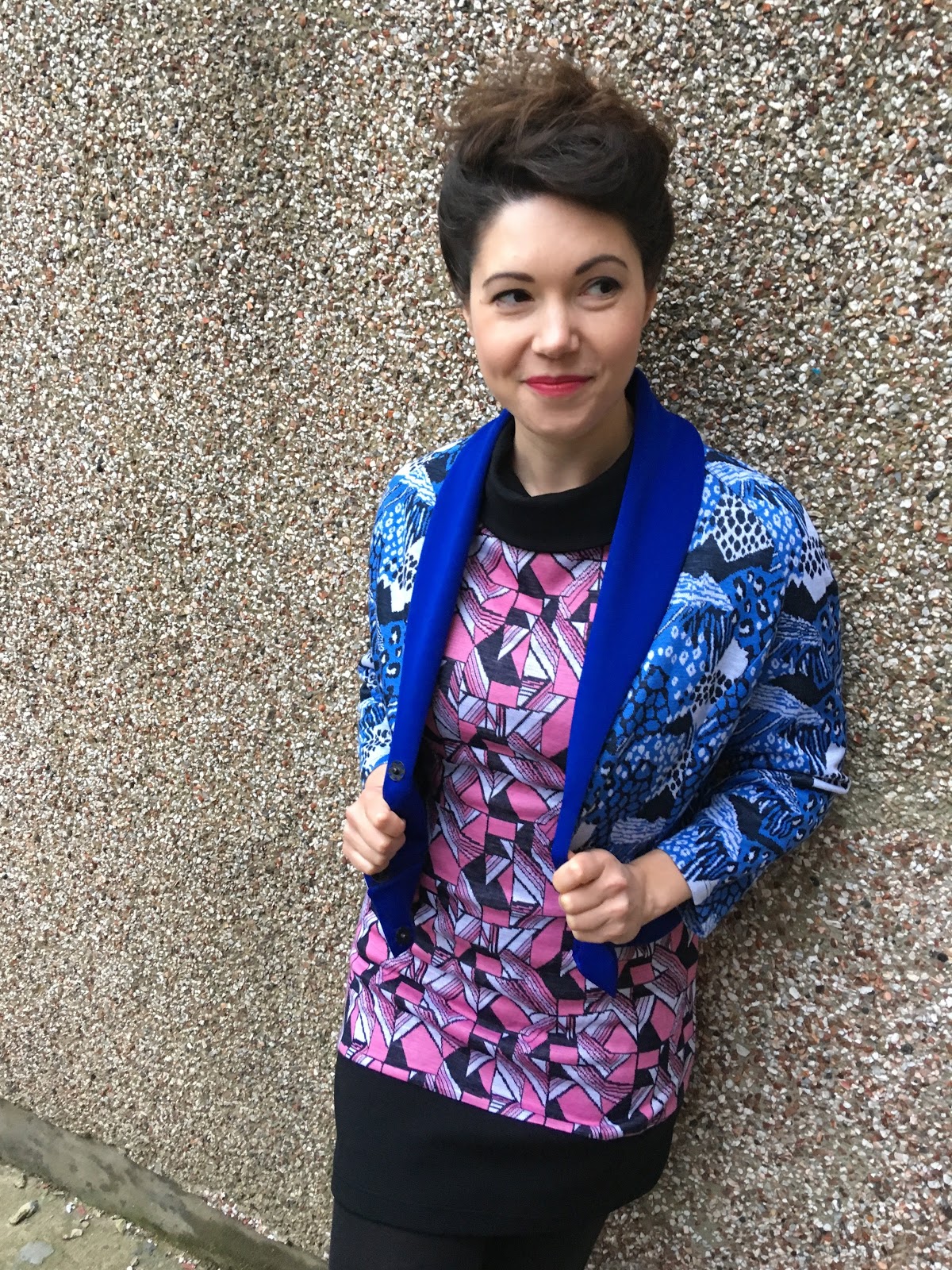
I bought two small-ish pieces of printed jersey in a charity shop, and was planning to make them into tube skirts, to wear with a black t-shirt or sweater. This wouldn’t have been the most efficient use of the fabric though, and I had some raglan sleeve dress and jacket patterns I had spent some time developing but had only used once. I had to use some scraps of contrast stretch fabrics to have enough for collars and a decent length hem on the dress, but I’ve ended up with two fun, eye-catching garments, and I regret nothing!


I went to a screening of the documentary River Blue this week, and although the film contains some pretty dire statistics about the state of the planet’s rivers as a result of pollution from the fashion industry, that isn’t the only message. The film also follows designers who are revolutionising denim production and finishing with new environmentally friendly techniques, and interviews the original designers of the finishing processes, who are completely supportive of these new ideas. Rethinking received wisdom and trying out bold new ideas is what fashion design has always been about, and the film has inspired me to explore new innovations and work them into my wardrobe, so check back for some futuristic fashion posts coming up soon.

Sunday, 29 October 2017

Ethical Consumer Conference: challenging corporate power, constructive campaigning and ethical blogging!

On Friday 20th October I attended the Ethical Consumer Conference, to learn how I can be a more engaged and active conscious consumer! The conference is organised by Ethical Consumer magazine, which helps consumers to make informed choices based on their personal ethics by rating brands according to their ethical credentials. The theme of this year's conference was “Challenging Corporate Power” which often seems impossible as an individual consumer, so I was looking forward to meeting like-minded people and hearing some positive messages.


The day started with a short presentation by Rob Harrison, the founder of Ethical Consumer Magazine, about its work challenging corporate power. We’re all aware of the global power of big corporations, but did you know that some have an annual turnover greater than the GDP of most countries? If Walmart was a country, it would be the 22nd richest in the world! Corporations tend to focus on their short-term self-interest, and trade deals like TTIP, or media monopolies, can allow corporations to take control of democracies. 

Ethical Consumer Magazine seeks to challenge corporate power, in part by simply informing the consumer. Their ethical indexes point out companies that are engaged in political lobbying or the funding of political parties. Rob explained that the magazine’s current policy was that corporations should have no place in our democratic process, but the idea of “lobbying for good” was going to be a recurring topic throughout the day; could consumers and politicians work with corporations to achieve positive change? 


Next, we heard from Richard Wilson, the founder of Stop Funding Hate, and Sean Dagan-Wood from Positive News, who spoke about how consumers can challenge corporate media. Richard described how his campaign had come about after seeing negative headlines about immigrants on an almost weekly basis in the Daily Express, the Sun and the Daily Mail, coupled with a spike in hate crime. Even though the readership of these papers is dwindling, and most of us are boycotting those papers by default, we are still subsidising them by buying products or services from the companies that advertise with them. 

Stop Funding Hate aims to persuade companies to stop advertising in these newspapers by gently suggesting that they wouldn’t want their products to be associated with hate speech. Richard talked about the importance of debating politely, and emphasising the values that we should be promoting instead; empathy, respect, civility and neighbourliness. By running a non-political campaign based on defending basic values, Stop Funding Hate empowers consumers to make a difference as part of a wider movement, and shows companies that funding hate doesn’t make economic sense. Publicity from Lego withdrawing advertising from the Daily Mail prompted similar action in other countries, notably in the US, where the ‘sleeping giants’ campaign persuaded many companies to stop advertising on far-right websites.


Sean from Positive News spoke about the importance of having a constructive voice in the media, rather than the destructive angle taken by a lot of newspapers. The focus of Positive News is to highlight good things that are happening in the world, but in a serious and relevant way, rather than trivial or lighthearted “and finally” news stories. The Constructive Journalism project is focussed on a high standard of reporting, and solution-focussed angles to stories, framing people as resilient, rather than victims. 

Sean is seeking to challenge the assumption that news should always be about the things that are going wrong; in his view, the news should hold power to account, but a constant barrage of negative news stories is causing a drop in engagement with the news. These negative stories have a damaging impact on mental health, making us feel helpless and fearful. Positive news, on the other hand, can boost our wellbeing, giving us a sense of hope and optimism. The magazine is run as a co-operative, through crowdfunding, meaning that it truthfully reflects the values of its owners. This is a difficult time for the newspaper industry, and Sean advised us all to support the media that takes an approach that mirrors our values.

Hanna Thomas from SumOfUs gave an engaging presentation entitled "10 things every corporate campaigner should know" with tips on creating a focal point for your campaign and getting media attention, how to exploit a company’s weak points (subverting their branding, appealing to the financial interests of their shareholders and pressing the advantage of bad publicity), and how to ensure the success of your campaign. She spoke about the importance of getting your facts right so your campaign is seen as legitimate, and the advantage of forming diverse coalitions with other campaign groups to amplify your voice and get through to a corporation’s target demographic. She also emphasised the value in celebrating corporations for getting it right, as it reinforces their willingness to make positive changes in the future, and finally, the need to live your values by avoiding replicating the bad behaviours you are campaigning against.


My chosen workshop session for the morning was "how consumers and campaigners can constructively engage with corporations". Paul Monaghan, the CEO of Fair Tax Mark, told us some of the lessons he had learned over years of campaigning:
  • Framing matters: never make your idea sound radical or ‘lefty’
  • Framing matters: your image and tone are part of your message

(I’m good at one of these and terrible at the other!) 
  • You can't just be against something, you have to stand for something
  • Indexes and awards drive companies to change
  • You’re only successful if you get past the PR department!


We discussed our experiences of campaigning in small groups; I shared what I had learned from taking part in Fashion Revolution Week; I definitely didn’t succeed in getting past the PR department when I asked H&M “who made my clothes?” but another attendee pointed out the growing reach of the social media campaign since it started, as well as the fashion industry’s new transparency index which seems to be driving change. We all agreed that persistence and a positive attitude were also key to campaigning; it just isn’t possible to change company policy with a tweet!


After a delicious veggie lunch and an opportunity to browse the stalls of some ethical businesses, we heard from Paul Ellis, the Chief Executive of Ecology Building Society, about the challenge of providing financial services that serve people and the planet rather than corporate interests. I hadn’t stopped to consider ethical financial services, but as Paul pointed out, unethical banks were responsible for an artificial housing boom and the financial crash that followed, with their complex products disguising the severity of the problem until it was too late. The Ecology Building Society is working with London Community Land Services to fund affordable homes and incentivise sustainable lending. The perception that this business model is more risky is not borne out in reality, but value-based financial institutions need the support of ethical consumers! Something else to add to my long-term sustainable lifestyle to-do list! 

My chosen afternoon workshop session was Ethical Bloggers skillshare, run by Emma Oddie, and Sian Conway, the founder of the Ethical Hour Twitter chat, which has introduced me to lots of like-minded ethical consumers and has improved my experience of Twitter immeasurably! Hopefully Emma’s advice will lead to a marked improvement in my blog posts (I’m trying to write shorter sentences, I promise!), but both speakers gave great overall advice for anyone trying to raise awareness or campaign on any issue. Sian stressed the importance of being an engaged member of the community and adding value (whether that community is based online or offline), while Emma emphasised the power of a positive message; changing people’s minds by engaging readers in your passion, focusing on solutions rather than just pointing out problems. Hopefully that’s what I’m doing here; I’m always delighted when someone tells me that my blog has prompted them to take good care of their clothes or attempt an upcycling project.


The final session of the day was four short presentations and a panel discussion about corporate lobbying. First to speak was Claire McCarthy, the CEO of the Co-operative Party. She believes that mixing business and politics doesn’t have to be negative; by focusing on their values and principles rather than short-term commercial interests, and showing leadership rather than demanding action from others, corporations can make a positive difference.

Paul Monaghan pointed out the need to take a nuanced view of the role of corporations in modern life; a lot of multinationals might be a positive influence in some areas of public life (for example, environmentally friendly innovation), while being a negative influence in others (e.g. tax avoidance). He made a compelling case that ethical businesses could lobby successfully for progressive public policy.

Vicky Cann from the Corporate Europe Observatory described how big businesses have more access to government representatives than anyone else, and how they can use this influence to shape policy and evade responsibility. She wants to see more transparency and better freedom of information rules to make sure that decisions are made for the good of the citizens of a country, not for corporate interests.

Finally, Nick Dearden from Global Justice Now outlined the problems with current trade deals that enable big businesses to lower standards because they have the power when a deal is being negotiated. These deals (like TTIP) erode our democratic rights and make profit the focus, at the expense of everything else. His vision for better deals would include built-in guarantees that standards would go up rather than down, and a move towards co-ops and away from monopolies and privatisation.


The Q&A, unsurprisingly, was very Brexit-focussed, with the panellists split on the need for a second referendum, or the need to push for a positive future outside the EU that puts people before profit. The EU is vulnerable to lobbying by corporations, but it’s also where some of our most progressive consumer legislation comes from, and the lack of coherent policy on Brexit meant that there were no clear answers.

I consoled myself afterwards with a glass of wine and the company of other members of the Ethical Hour community. It was lovely to put faces to the business accounts I interact with every week, and to chat to other people who are living their values. If you’re interested in finding out more about Ethical Hour, you can join in the chat on Twitter from 8-9pm on Mondays using the hashtag #ethicalhour ; hope to see you there!