Showing posts with label fast fashion. Show all posts

Sunday, 21 July 2019

Rebellion on the High Street! Protesting fast fashion with XR Sutton

Discussing ethical and sustainable fashion with likeminded or open minded friends on social media is great, and I’m thrilled that there’s such a creative and ever-growing community of people who care about clothes, the people who make them and their impact on the environment.


But sometimes I worry that I’m preaching to the choir, that my blog posts aren’t reaching the people who I think need to read them: the people who are trapped in a cycle of buying unsatisfactory clothes and then discarding them on the off-chance that if they do this enough it will make them happy. 


So I was excited when my local Extinction Rebellion group planned an action to protest the destructive nature of fast fashion, which would take place on Sutton High Street. Not only was it a cause I care deeply about, I also felt well-versed enough in fast fashion facts to be able to contribute to the leaflets the group was preparing and even to speak on local radio about the protest. I was also curious (and a little apprehensive) about what the reaction from shoppers might be. Being confronted by the negative aspects of something you enjoy doing can bring on feelings of defensiveness, and it’s often unpleasant and uncomfortable to sit with this reality, and consider how you have contributed to the problem and what aspects of your behaviour need to change.


XR Sutton set up a table in the middle of the pedestrianised High Street outside the shopping centre on Saturday morning, and a group of protesters formed a human washing line, decorated with facts about the fast fashion industry. Other protesters surreptitiously added labels to fast fashion garments in stores, acted as human mannequins in shop windows and staged a die-in. The rest of us handed out leaflets and chatted with shoppers, and I thought it might be interesting to share some of the interactions I had during the three hours I was there.


“I’ve worked in a local charity shop for seven years. We try not to waste any donations - the rag man comes and takes any clothes we can’t sell in the shop. Another girl does the pricing - she knows all about labels. I ask her why those flip flops are £15, and she says “oh, they’re by this designer, and they are over £100 new.” I can’t believe people pay all that money for something then give it away.”

Mum: “we’re just off to a charity shop now to find a costume for my daughter, she wants to be Queen Victoria for a costume day at school.”
Me: “that sounds like fun!”
Mum: “I don’t know where to start!”
Me: “look for a big skirt, something with lace…”
Daughter (very excited): “we’re going to pad my bum with a cushion!”
Mum: *sigh*

“I don’t want a leaflet, weirdo”

Older man: “what kind of person lies in the middle of the road on a Saturday afternoon?”
Younger man with family: “well, I wouldn’t,  but I’m glad some people are, it needs to be done”

Father: “so it’s bad to buy new things?”
Me: “every garment that’s produced has a big environmental impact. If you buy secondhand or keep your clothes for longer you’re reducing that impact and helping to save the planet.”
Father (to daughter): “are you listening? Not too many new things.”


“In my young day (which was a long time ago), no one would dream of throwing clothes away. I didn’t know about the pollution though, that makes me worry. When I was a child, no one had asthma or allergies. Now they all do, because of the pollution. Something’s got to change.”

“WHY AREN’T YOU WEARING HESSIAN SACKS LIKE IN THE OLDEN DAYS?! THAT WOMAN OVER THERE IS WEARING A NICE DRESS! YOU’RE ALL HYPOCRITES!!

“It’s so nice that you’ve got drawing here for the kids to do. We took them to Marble Arch during the April protests and they loved it. We didn’t know there was a local group, we’d be really interested in joining”.

“I don’t want to disrupt the die-in but can you make sure they stay hydrated?”

And probably my most frequent interaction:

Shopper: “so what’s this all about then?”
Me: “we’re trying to raise awareness about the problems with fast fashion; we’re encouraging people to think about whether they really need something new, or whether they could buy secondhand or vintage, or swap clothes with friends.”
Shopper: “I love going to charity shops! I got this *proudly displays item of clothing* from a charity shop, it was a bargain!”


Overall, despite some people flinching away from the Extinction Rebellion leaflets as though they were radioactive, the reactions were more positive than negative. Some people just wanted to ignore us, and the woman who yelled at me left me speechless because her reaction was the exact opposite to what I had been expecting. The complaint I’m used to hearing in discussions about changing our shopping habits is “why can’t I have nice things?” as though sustainable fashion is the very opposite of a nice thing. My fellow fashion activists and all the amazing sustainable brands I know of are all doing their utmost to show that this is not the case, and that sustainable fashion is just what all fashion ought to be - creative, beautiful and kind to people and the planet. To someone who knows quite a bit about fashion history, the “hessian sacks” comment was almost comically ignorant - in the past, clothes were some of the most expensive and treasured possessions a person could own, and were well cared for. Even the “sackcloth” dresses of the Depression era were made from tightly-woven cotton flour sacks (which the flour companies would often print with novelty patterns as they knew the sacks would be re-used for clothing). But there’s no chance of telling someone some interesting facts when all they want to do is have a shout. 


The protest, and the reaction to Extinction Rebellion as a whole, has given me a new facet of activism to think about. Some people who are desperate not to see a change in the status quo will think that you’ve been “caught out” when they point out the fact that you still live within modern society. This is also very much at odds with the online community activism I’ve been taking part in, where the focus is on doing something rather than nothing, and making the small changes that will quickly add up. For the record, I don’t think I’m a hypocrite for wanting to change the world I live in. If I ran away to live in the woods (tempting though it might feel at times), nothing would change; industries would carry on polluting and destroying the planet, and eventually that destruction would come to the woods too. 


I had an interesting conversation with a friend later on that day about the five stages of grief, and how these could relate to people’s reactions to being confronted with the realities of climate change. While XR Sutton as a whole works on getting our local council to declare a climate emergency, and encouraging them to create meaningful change through the implementation of their environmental policies, I’m also going to be working on my personal strategy as a sustainable fashion activist. How do I respond to people’s anger, fear, disbelief and cynicism in a way that’s creative, positive and kind, and doesn’t leave me at risk of burn-out?


If you’re interested in the work that Extinction Rebellion are doing about fast fashion, you can find out more on their Twitter or Facebook.

Photos of the protest taken by fellow Sutton Rebel Bill Mudge.

Monday, 22 April 2019

Worn Out: the story of the clothes we throw away

Last year, people in the U.K. sent 350000 tonnes of clothes to landfill. I don’t know about you, but I find this impossible to visualise. Even breaking it down to a figure per person - approximately 5kg - it’s hard to imagine what that might look like. So I created Worn Out.


My sister and I, both recovering fast fashion addicts, had bags of clothes that we were absolutely planning to take to textile recycling. One day. When we got around to it. When we weren’t busy with something else. I combined the contents of these bags, and it turns out that this is what 5kg of clothing looks like! 


Before you ask why we didn’t donate these clothes - these weren’t clothes that charity shops or clothes swaps would accept. Threadbare pyjamas, ratty t-shirts, leggings that had burst at the seams, even (gasp!) my old knickers! These are the clothes that are most likely to end up in landfill. 


Even with the best will in the world, our clothes aren’t going to be wearable for ever. While more and more people are embracing secondhand shopping and swapping as a way of ensuring their unwanted clothes won’t go to waste, not every item of clothing is going to be a desirable pre-loved purchase. Most of us are going to end up with a collection of t-shirts, leggings, underwear or worn-out clothes that no one else wants.


While fast fashion isn’t “designed to fall apart”, the choice of cheap fabrics to keep costs down means that basic everyday clothing might be more delicate than we think it is. A washing machine cycle with a high temperature and a fast spin, or tumble drying, can wear down fabrics even faster, leading to a high turnover of clothing in our wardrobes. 


If we send these clothes for textile recycling, they are likely to be downgraded, into stuffing for pet beds, car seats or insulation. At the moment it’s a difficult process to re-use fibres from old clothes, as natural fibres need to be separated from synthetics, and most fast fashion clothing is made from a mixture of both. The shredded fibres then need to be mixed with new fibres in order to spin them into a good quality thread.


While businesses like Rapanui/Teemill and Swedish Stockings are closing the loop in their own supply chain by incentivising customers to return their worn-out clothing, this isn’t happening on a large enough scale to make our current consumption of clothes sustainable.


I’ve constructed Worn Out to show the sheer volume of fabric that could be re-used if we create a more circular fashion system. Think of the possibilities! I wanted Worn Out to look equal parts comical and overwhelming; this is a garment that wears you, and isn’t designed to look flattering (the passing resemblance to the memorable scene in Friends where Joey wears all of Chandler’s clothes isn’t entirely coincidental). The amount of clothing we throw away is absurd, and the way we are encouraged to consume clothing as though it was disposable is absurd. We can’t wear more than one outfit at once, and overconsumption isn’t making us happier or more fulfilled.


Ideally I’d like Worn Out to be an interactive piece of wearable art, something that other people can touch and even try on. It’s going to be making an appearance at the Ethical Influencers meet up and clothes swap for Fashion Revolution Week so hopefully this will be the first of many outings.


As a costume maker and a vintage fashion fan, I’m passionate about clothes as a means of storytelling. Worn Out tells a story about my wardrobe, but it's not the story of favourite clothes or treasured heirlooms. It’s the story of the hidden side of fashion, the parts we don’t show off on social media. It is partly a story of fast fashion failures; the t-shirts with warped seams, the leggings with insufficient elastic, the mistaken belief that fine jersey embellished with metal or plastic can survive a 40 degree wash and spin without ending up full of holes. But it’s also the story of the life I’ve led while wearing these clothes, and how some of them have come to the end of their useful life naturally. My body shape has changed over the years so certain bras no longer fit. Old t-shirts have been downgraded to painting clothes until they are so threadbare that paint has gone right through them. I’ve worn pyjamas for thousands of hours, despite the fact that I don’t really remember it. These clothes have kept me warm in winter, and cool in summer. Some of these clothes have travelled to different countries with me, others have never left my house.


The weight of Worn Out as it settles around your shoulders might feel like a burden, but I prefer to think of it as a reminder of our responsibilities. To look after and appreciate the clothes that hardworking people have made, and to think carefully about what happens to your clothes when you part ways with them.


In case anyone’s wondering what’s left over from Worn Out; it’s not a perfect zero waste garment but I did diligently save every scrap that didn’t make it onto the final design. This little bag of scraps creates an accessory to accompany Worn Out, and serves as a reminder that we can keep improving our ideas for a zero-waste fashion system.


Thursday, 14 June 2018

I'm giving sleeves the cold shoulder

It all dropped into place as I was watching the film “Hidden Figures”. As Taraji P Henson’s character, real-life NASA mathematician Katherine Johnson, climbs a ladder and raises her arm to begin writing on a huge blackboard, her dress just... stays put. The hem doesn’t lift awkwardly, the fabric of the bodice doesn’t bunch around her shoulders and neck. She looks focussed and poised, her dress an eye-catching flash of bright colour amid a sea of grey as she formulates the safe return of a person from space. 

The success of a dress can hang on its sleeves, and, once again, fast fashion is letting us down. 


As a woman in my mid 30s, the perceived wisdom is that I should be desperate for clothes with sleeves (presumably to cover my unsightly upper arms and armpits in case they are *gasp* sweaty or *double gasp* hairy). In fact the exact opposite has happened, and you will rarely find me sporting a sleeve. While I may not have the perfectly toned arms of an A-List star in a red carpet gown, I see no reason why my completely average arms should be a source of shame. If you are bothered by my (mostly shaved, but sometimes stubbly) armpits, perhaps worry about something else instead of policing women’s bodies? 

But I’m not just going sleeveless as a gesture of defiance against oppressive beauty norms, I’m not wearing sleeves because they just don’t fit properly. If you’re wearing a non-stretchy fitted top or dress, lift your arms above your head. Does the whole garment follow you? Does it stay rucked up when you lower your arms? Doesn’t that annoy you? Sleeves have become a complicated part of a garment, and fast fashion just doesn’t seem to be getting them right. 


I don’t blame pattern cutters; I’ve had trouble with sleeves ever since I drafted my first (terrible) sleeve pattern in my first term at uni. I’ve had years to practice drafting sleeves of every shape and size, and my initial pattern almost always needs tweaking. The difference between my pattern cutting experience and that of someone who sends their patterns off to a factory is that I have to take into consideration any requests from actors or private customers for better freedom of movement, and I usually have the luxury of time (or at least more time than the few seconds a factory worker would be given to sew a sleeve). 


The “factory method” is to machine the armhole with the garment lying flat first, then machine the sleeve seam and side seam all in one. This means there is very little ease in the sleeve head, not so much of a problem for people with a flatter chest, but not ideal for those with a full bust. The method I use for a couture garment is very different; I machine the side seams first, place the garment on the stand and then “balance” my sleeve, pinning it in place to check that it hangs correctly. I don’t always line up my sleeve seam and my side seam; sometimes setting the sleeve seam a bit further forwards can give some extra ease for a larger bust (this ease can help to prevent gaping on a button-down shirt. So can proper button placement, but that’s a rant for another time). I sometimes add a (historically inaccurate) grown-on gusset to certain styles of historical costume (or modern clothing) to allow for more underarm movement, but there are plenty of examples of historical sleeves where this simply wasn’t a problem. 


Up until the 19th Century, men’s shirt patterns were a simple series of squares and rectangles, with a diamond shaped gusset under the arm to allow plenty of movement. The creative pattern cutting of post-war mid-century fashion revisited this idea.  Despite its ubiquity in fashion photography, many women weren’t fans of the ultra-feminine New Look. After experiencing the freedoms afforded by paid work and practical uniforms during the Second World War, they were reluctant to go back to restrictive clothing. 


I found some great examples of the compromises made by enterprising dressmakers in the ladieswear department of the costume house in London where I work. These smart dresses all have cleverly constructed sleeves or underarm gussets to allow for movement in an otherwise fitted and demure dress. Compared to my high-street fitted dress with sleeves, the waist seam on these vintage dresses barely shifts when I raise my arms and I didn’t feel nearly as uncomfortable in a 70-year-old dress as I did in a modern one. 


We look at historical clothing in museum collections and marvel at how restrictive it must have been. But unless we are wearing stretch fabrics, our modern clothing isn’t much better. As the cost-cutting measures that enable fast fashion’s artificially low prices restrict the amount of time spent adjusting patterns and stitching garments, we are literally restricting ourselves in poorly thought-out clothes.

In this day and age, we pride ourselves of finding creative solutions to improve efficiency (even when, sometimes, these solutions were there all along). Maybe we need to take a more creative approach to pattern cutting and garment construction to provide the freedom we expect (and need) from modern clothing.

Thursday, 26 April 2018

How to become a Fashion Revolutionary

The fashion industry is vast, complex and opaque. Even if you are concerned about how the clothes you choose can impact people and the planet, it can be daunting or overwhelming to know where to start to equip yourself with the knowledge that will help you make informed choices. Fashion Revolution Week provides an opportunity to join forces with one another and collectively push for change, but if you don’t feel confident about asking tough questions, here’s how you can quietly start your own revolution using just the contents of your wardrobe.


See fast fashion garments as works in progress rather than the finished article
I am a professional dressmaker, and even if I have an exhaustive list of measurements and a mannequin padded to a client’s shape, I’ll still have to make adjustments to the garment I am creating during fittings. Not only is every body unique, but everyone has their own unique feelings about their body, and which parts of it they would rather reveal or conceal. 


One of the things we sacrifice when we choose cheap fashion is fit. A generic sized garment probably won’t fit anyone perfectly, but we can be reluctant to spend money on alterations when they might cost more than the clothes themselves. If you buy enough cheap pairs of trousers, one of them is bound to fit, right? As anyone who has ever reached the end of their tether in a high street fitting room (or at home surrounded by online purchases that all need returning) will know, this doesn’t often work out well. Instead of buying lots of cheap clothes that don’t fit, why not spend some of that money on making sure your clothes fit perfectly? Sewing courses (like the ones run by Sewing Bee producer The Thrifty Stitcher) can teach novice stitchers the basics in a few hours. Alternatively, if sewing isn’t your thing, support a local business by paying a tailor to perfect your wardrobe.


Avoid obsolescence 
The fast fashion cycle relies on ever-changing trends to persuade people that they constantly need to buy new clothes. Magazines that rely on brand advertising will praise a style in their “must have” column one month, only to deride it as “so last season” the next. My dad has an interesting theory about the recent craze for pre-distressed denim: he reckons it is a way to speed up the lifespan of a garment, requiring us to buy more products. Fabric that has been worn down with sandpaper or sprayed with chemicals isn’t going to last as long as pristine new fabric. I think it’s part of the fun of owning clothes to naturally age them by wearing them, and refashioning or mending them as circumstances or personal style dictate. By developing this relationship with my clothes, I see them as valuable belongings rather than disposable items. 


Break the rules
A lot of us end up with clothes we don’t really wear because we feel obliged to buy them, especially for parties, weddings or other formal occasions. If you love having something new to wear that’s fine, but if your wardrobe is filling up with clothes that you have only worn once, you might need to re-think your approach. You can hire contemporary and vintage clothes for a special occasion; a designer label suddenly becomes more affordable when you only want the garment for a weekend. You could also search charity shops in a well-heeled area for other only-worn-once occasion wear.


I’m not a big fan of dress codes, especially when they are designed to discriminate or make people uncomfortable. I have an aversion to high heels but I’ll wear fancy flats with a posh frock, and I think this is an acceptable compromise! It just isn’t worth buying clothes because you think you ought to; your own comfort will give you more confidence than clothes you’ve just bought to conform. I feel more comfortable being overdressed than underdressed, my main concession to practicality being my footwear! Of course, I wouldn’t wear a vintage evening gown to hike up a mountain, but I like wearing a skirt if I’m just going for a stroll. Finding a personal style that means you’re always comfortable is an important step towards buying less clothes that you won’t end up wearing.


Relax and enjoy fashion
I know this is much easier for me to say than for many people to do. Factor in body-shaming and outfit-policing in the media, and “what not to wear” lists, and a purchase that you were looking forward to wearing ends up languishing at the back of the wardrobe for fear it will invite unwanted attention or criticism. I think we all could start to treat each other with more kindness and compassion in general, but we could all examine the snap judgements we make about other people’s outfits. Is it really any of our business if they dress in a way we wouldn’t want to ourselves? 

In its ideal form, fashion is meant to be a form of self-expression, to let the world know who we are, or who we aspire to be. This isn’t possible if we are being sold cheap, ill-fitting garments that don’t make us feel good about ourselves. It’s possible to create radical change if enough of us can break free from this cycle of dissatisfaction and obsolescence. 


Fashion Revolution offers template letters to send to brands and policy makers if you want to start asking Who Made My Clothes but don’t feel that you know enough about the subject, or the right questions to ask. Their website is full of helpful information, including access to their online zines, as well as their Transparency index. This provides information about well-known fashion brands and how much they disclose about their supply chain, so you can make well-informed decisions about where to shop.


I would love to get to a point where I can just enjoy fashion in an uncomplicated way, without having to research every purchase or avoid a lot of shops altogether. We have a long way to go before that happens, but fashion is a creative industry and I am hopeful that enough talented and dedicated people are working hard to make a change. Until that happens, we can all be fashion revolutionaries by rejecting the negative aspects of the industry, supporting people who are making positive changes, and demanding positive changes from the multi-million-pound brands that have the resources to be at the forefront of change rather than lagging behind.

Sunday, 18 February 2018

5 reasons why fast fashion (probably) won't fit you

How many times have you picked up a garment from a high-street shop (which wasn’t super stretchy) that fitted you perfectly? It’s a great feeling when it does, but most of the time that’s not what happens. We’re left contorting ourselves in the changing room mirror trying to find the garment’s best angle, wondering what we can wear it with to hide the bit we don’t like or planning to cinch it in with a statement belt. 


It’s not surprising that high street clothes aren’t a perfect fit, when patterns are initially developed for a fit model (who probably has a very different body shape to the majority of people), and then graded up and down to (imperfectly) fit a range of sizes. Our dissatisfaction with these imperfect clothes increases our rate of consumption as we discard all those outfits that never really worked in a fruitless search for that elusive perfect fit. 

Understanding why our clothes might not be ideally suited to our bodies is an important step towards having a more positive self image, and reducing our consumption of clothing that makes us feel unhappy. Here are five things I’ve come to understand about the fashion industry that have helped me change my habits.


There is no standard sizing:
For gender neutral garments like jeans, there are more straightforward sizing options to give shoppers a fighting chance of finding something that fits. Measurements for the waist and inside leg length, as well as a description of the expected fit (skinny, tapered leg etc) help to narrow down your options (although I’d argue that a hip measurement would be helpful too). For women’s clothing sizes - size 10, 12, 14 etc- there are no standard measurements, brands can decide for themselves what measurements they want to allocate to each size. This might be determined by a profile of their average customer, their age and lifestyle, with the concept of “vanity sizing” - giving a garment with larger measurements a smaller-sounding size to encourage customers to buy it - complicating matters further. 

Big brands are likely to use different fit models for different ranges, and send patterns and samples to different factories, increasing the likelihood of discrepancy in sizing. When I was checking labels to find out what my clothes were made from, and where they were made, for my Wardrobe Diary, I noticed that I had clothes in a range of sizes from certain brands, even though my body shape hasn’t noticeably changed for years. Of course, clothing is designed with a specific fit in mind, and there is nothing to stop customers buying a larger size for a looser fit, but it can add to a sense of confusion about sizing, especially if the clothes aren’t shown on a model to give an idea of the intended proportions. 


All bodies are unique:
This excellent interactive size chart, What Size Am I? is a real eye-opener if you always feel disappointed that high street clothes don’t fit quite right. Enter your bust, waist and hip measurements, and you can see how your body shape corresponds to the measurements used by different high street brands for each of their sizes. 

Of course, the body is three-dimensional, so even if your measurement corresponds to the measurement given by a brand on their sizing chart, that doesn’t necessarily guarantee a good fit. If your proportions are different to those of the fit model, that can cause fit issues. My 35 inch bust measurement could easily apply to someone with a larger rib cage and smaller breasts. It could encompassa range of bra sizes from an A to an E cup, which can make a huge difference to the fit of clothes.

When standard size patterns are “graded” (converted into a range of different sizes by increasing or decreasing the proportions of the original pattern, usually designed for a size 12), this is usually done in uniform increments, which is not the way the human body develops! Anyone with a longer or shorter than average torso, a fuller bust or wider hips, can find their body shape at odds with conventional sizing. 


Clothes are designed to optimise manufacturing efficiency, not fit:
If you study a beautifully proportioned 1950s suit, a chic 1940s tea dress or a drapey 1930s gown, you’ll see that the construction of these garments is pretty complicated. Intricately shaped pattern pieces, carefully positioned darts and hidden padding or boning all contribute to a perfect fit. These features correspond to a unique body shape, and garments with many different pattern pieces and lots of detailing are time-consuming, and therefore expensive, to make. Simple, boxy shapes that need minimal machining make a more efficient use of fabric, and a loose-fitting garment is less likely to be rejected in a fitting room if it isn’t an exact fit.


People in the public eye get a helping hand:
Whether we’re looking at a celebrity at a red carpet event or the host of a TV show, if they are looking flawlessly dressed it’s probably because they have had behind-the-scenes help from more than just a stylist. As well as having clothing selected for them to ensure that they look perfect, whatever the occasion, anyone with a role in front of the camera is probably having their outfits altered by skilled seamstresses like my friend and former colleague  who runs Grace Lane Studio. Brands want their clothes to be seen in the best light for any sort of advertising campaign, and altering the garment itself is less noticeable in a world which is becoming ever more savvy to airbrushing or digital manipulation. 


It was never intended to.
From the simple shape of a 1960s A-Line mini dress to the snug embrace of a body-con “bandage” dress, the styles that have transferred most efficiently from high fashion to fast fashion rely on a cut that skims over the exact shape of the body, or a fabric that stretches and moulds to the body. Our most comfortable mass-produced purchases are probably either loose or stretchy (or both) because it’s impossible for fast fashion to perfectly fit every one of its millions of customers.


I’m not suggesting that we should all ditch factory-made clothing entirely and only wear couture or clothes we’ve made ourselves; factories have the advantages of economies of scale, bringing prices down to an affordable level, and specialist hardware, software and expertise that have been used to create clothing we’d struggle to duplicate at home. We do need to remember, though, that we can’t expect perfection from fast fashion, and it would be great to start normalising altering clothes to get the exact fit or style we want.


I’m going to put some tips and ideas up on the blog in the near future, so keep checking back, but if you know you’re unlikely to do the alterations yourself it’s worth doing some quick calculations to see how paying for alterations could actually save you money when you’re shopping on the high street. If you buy a pair of trousers for £30, but only wear them three times because you’re unhappy with the fit, they have cost you £10 per wear. If you spend an extra £30 on getting them professionally altered to fit perfectly, and you wear them thirty times (the ethical fashion community’s baseline for a garment to be worth buying), they have only cost you £2 per wear! Saving money in the long run and saving the planet seems like a win-win to me.

Thursday, 11 January 2018

My Fashion Wishlist for 2018: more imagination, less exploitation.

I’m conflicted about fashion at the moment. I’m uninspired by the clothes I see in fast fashion high street chain stores, but I visited six fashion exhibitions last year and I am eagerly awaiting upcoming exhibitions this year. I’m usually a traditionalist when it comes to fabrics, but I won’t stop going on about my comfortable and cool Po-Zu silver sneakers (“they are made from pineapples!” I shriek at anyone foolish enough to mention that they quite like my shoes). “Trends” to me seem to be stuck in a cycle (florals for Spring? How original!) but I’m always excited to follow young designers or ethical fashion start-ups on Instagram, and although I’m sentimental about the clothes I own and have a large wardrobe, I can’t seem to stop foraging in secondhand or charity shops in case I’m missing out on something. I’ve had to stop and think about what I want from the fashion industry, and more importantly, how to make it happen!


Fashion used to be shocking because it challenged stereotypes, subverted gender norms and broke down boundaries, now what’s shocking is the widespread worker exploitation and environmental damage. This is nothing new, the fashion industry was full of horrors in the past: after a Victorian craze for green dresses that were dyed with arsenic, the Triangle Shirtwaist factory fire in New York in 1911 killed 146 people when factory doors were locked and workers were trapped in the building. This led to the growth of the International Ladies’ Garment Workers’ Union, and improved legislation for workers’ safety in the US, but we should have left this sort of tragedy in the past: toxic dyes and factory disasters have no place in a forward-looking 21st century industry.


Looking back at the iconic styles of the 20th century, each decade seems to reject what’s gone before; experimenting with new silhouettes and new fabrics, revealing or concealing different parts of the body. Whether fashion was responding to or reacting against changing times, it kept changing with the times, producing iconic looks that we might reference with current trends or seek to recreate with vintage clothing, but which we can’t seem to break away from. If my generation’s impact on fashion is landfill sites overflowing with cheap, ill-fitting and disposable garments rather than the equivalent of a beaded flapper dress or a 60s mini, I’ll be angry and saddened; we’re better than this!


Mainstream fashion is polarised, seeming to consist of either extortionately expensive designer brands, or artificially cheap fast fashion. This leaves the vast majority of customers at a disadvantage; we’re told fashion is meant to make us feel good about ourselves, but does it? When it’s priced laughably far beyond our reach, generically sized so it doesn’t fit anyone properly, or contributing to humanitarian or environmental disaster, there seems to be very little feel-good factor left.


The good news is that there are plenty of independent designers and brands innovating to bring us clothes that are kinder to people and the planet, and I’m going to support them as much as I can this year. Rather than buying safe, “investment” pieces, I’m going to buy clothes that put a smile on my face, that I want to shout about. If I’m really happy with my clothes, I’ll want to wear the ones I own more often and will be less likely to keep looking for something new. Instead of focussing on negative statistics that make people feel hopeless and powerless, I’m going to seek out positive messages to spread about fashion innovators; the people designing the silhouettes, fabrics and manufacturing methods that our descendants will be reading about in fashion history books. 


I’m also going to apply the same high standards to the clothes I make for myself. I love the time I spend at work collaborating on intricate, unique clothes, but often make something simple and straightforward for myself, so I’m challenging myself to make imaginative use of my extensive fabric stash this year.


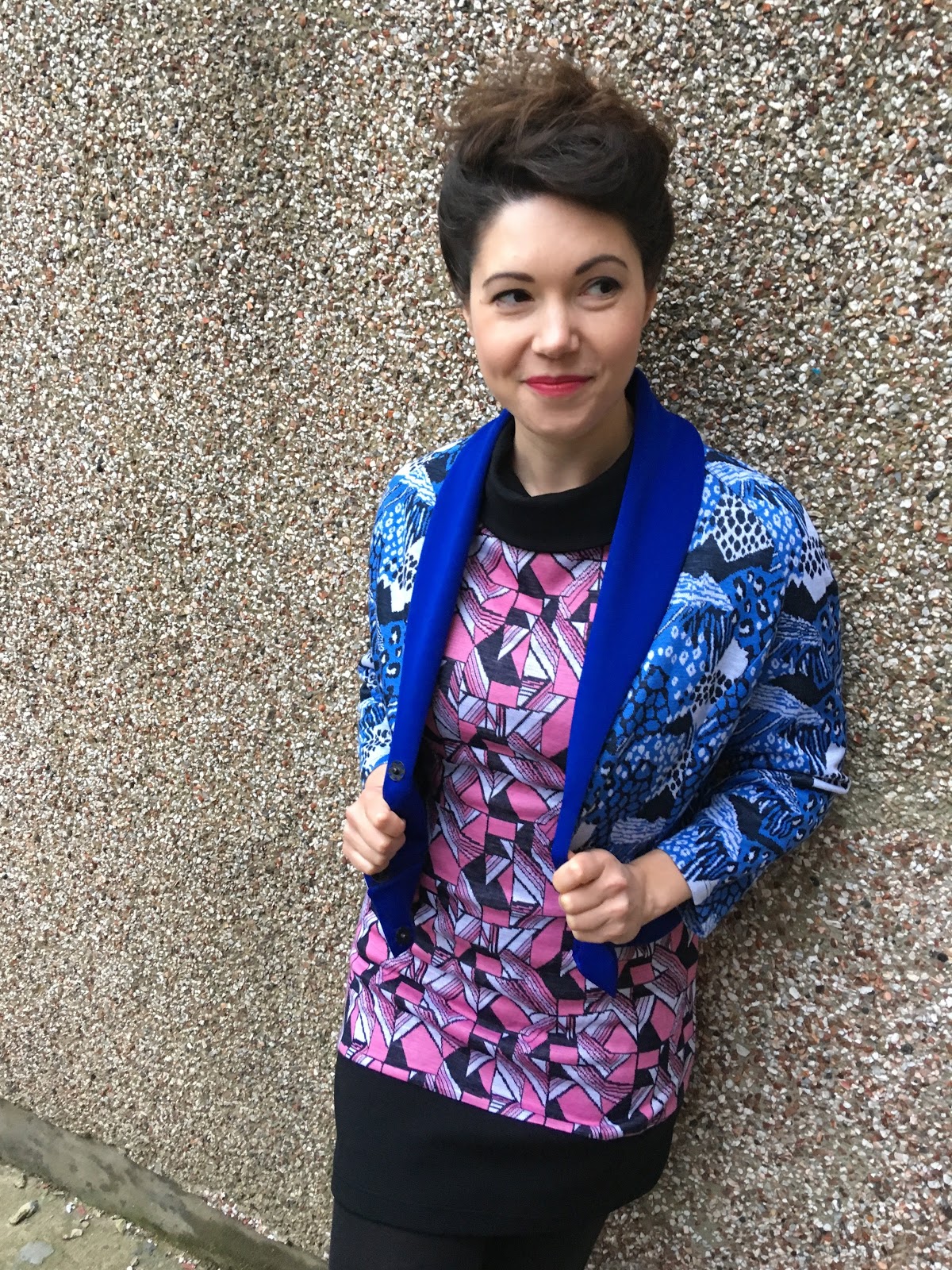
I bought two small-ish pieces of printed jersey in a charity shop, and was planning to make them into tube skirts, to wear with a black t-shirt or sweater. This wouldn’t have been the most efficient use of the fabric though, and I had some raglan sleeve dress and jacket patterns I had spent some time developing but had only used once. I had to use some scraps of contrast stretch fabrics to have enough for collars and a decent length hem on the dress, but I’ve ended up with two fun, eye-catching garments, and I regret nothing!


I went to a screening of the documentary River Blue this week, and although the film contains some pretty dire statistics about the state of the planet’s rivers as a result of pollution from the fashion industry, that isn’t the only message. The film also follows designers who are revolutionising denim production and finishing with new environmentally friendly techniques, and interviews the original designers of the finishing processes, who are completely supportive of these new ideas. Rethinking received wisdom and trying out bold new ideas is what fashion design has always been about, and the film has inspired me to explore new innovations and work them into my wardrobe, so check back for some futuristic fashion posts coming up soon.