Showing posts with label Labour behind the Label. Show all posts

Thursday, 12 October 2017

Our fashion choices can speak volumes about us, but we all need to be part of the conversation

Our clothing is a powerful method of non-verbal communication, and can have a really positive impact if we are able to make it work for us. But what do we do if the fashion industry isn't giving us the chance to say what we want to say? 


I've written about about the limitations of fast fashion when it comes to fitting or flattering our bodies, but I've also written about the fun we can have with our clothes, even indulging in some closet cosplay to give us the confidence of our favourite fictional characters when the going gets tough. I strongly believe that clothes should make you feel comfortable, both physically and psychologically, but I also think clothing works well as armour, equipping us to deal with challenging situations by projecting an image of strength, competence or resilience that perhaps we need a bit of help to feel authentically. 

I've been dealing with both physical and mental health issues recently, and sometimes the thought of everything I need to do in a day makes it almost impossible to get out of bed. But I know that flopping around in my pyjamas will only make me feel worse, so every evening before I go to bed I lay out a nice outfit, and every morning I force myself to put it on, to brush my hair, apply some make-up. Seeing the person I want to be looking back at me in the mirror reminds me that I am more than my problems, I have the strength to cope with difficult situations and work towards the goals I have set for myself. It might sound shallow, but looking good makes me feel much better about myself; it makes me feel like I should be out and about in the world, rather than huddling at home. 


My relationship with my clothes has changed and evolved since I became a more conscious consumer; taking part in Labour behind the Label's Six Items Challenge cemented my view of my favourite clothes as valuable and versatile rather than disposable, and while I'm thinking much more carefully about the clothes I buy new now, I also apply the same scrutiny to the clothes I already own. If my clothes aren't looking their best, or making me look my best, I alter them, mend them, or decide they weren't really meant for me and take them to a clothes swap or charity shop. I remember my dad making fun of the designer logo trend that was popular in the 90s ("they should be paying me if they want me to advertise their brand!"); it wasn't a fad I ever bought into, but I do want to be a good advert now for ethical and sustainable fashion. I want people to see that alternatives to fast fashion are smart and stylish, and to dispel the outdated and inaccurate stereotypes that occasionally still linger around eco-friendly or second-hand clothes. All the outfits I've worn this week feature clothes from swaps, second-hand shops, or are rejected manufacturing samples or things I have made myself! 


The fact that the clothes I am now choosing to buy are manufactured in ways that align with my personal values adds another feel-good factor to my wardrobe. I know I'm trying my hardest to have the smallest possible negative impact on other people and the environment; my values are lived, not performative. Ethical fashion blogger Tolly Dolly Posh makes a strong case for ethical and sustainable fashion as a feminist movement, and points out "FEMINIST" t-shirts need to be more than just a slogan stamped on a shirt that has been made in a sweat shop. This was certainly a concern for my friends at The Suffragette City, who didn't want their "Same Shit, Different Century" fundraising t-shirts and bags (created to raise money for Abortion Rights) to be asking for a better world through their slogan only. They chose to partner with Rapanui (through Teemill) a company who make their clothes and bags from organic cotton in an ethically accredited wind-powered factory.


There is an element of privilege here, because ethical products are often more expensive than their fast fashion equivalents, but there are also vast, global issues under the surface: if the average consumer's wages are so low that we are unable to clothe ourselves or our families without buying items made in sweatshops, should we be clamouring for more sweatshop-made clothing, or for global change that results in less wage inequality so that we can all have nice things? Ethical and sustainable brands are usually run by young entrepreneurs, keen to make a difference but aware that they have bills to pay. High street fast fashion brands are run by some of the richest people on the planet, who somehow still can't afford to pay their workers a fair wage. I know who I would rather give my money to! 


Ethical and sustainable fashion can be inaccessible for reasons other than cost; this Refinery 29 article features plus-size fashion bloggers discussing the problems they have faced trying to find clothes that fit their values and their bodies. I received a detailed and thoughtful email from my aunt, a savvy charity shop bargain finder (it must run in the family, my sister and cousin have a talent for it too!) who wants to find ethical fashion for older women at a price point she can afford on a pension. Although the new brands I have been looking at definitely seem to have more diverse models, it’s important for all customers to see themselves represented, so that ethical and sustainable fashion will be seen as the norm, as something for everyone, rather than as a niche purchase for people with money and the time to go searching online for the perfect piece of clothing. 

So what can we do to get the clothes we want, in a way that is good for everyone? We can ask for what we want! Contact small brands and ask if they can make something in your size (some of these brands work on a bespoke model in the first place to avoid the wastage of unwanted stock, so it might be possible without a large increase in price), or ask what their plans are for including your size in their range in the future. Sometimes a brand has to start with a capsule collection in limited sizes in order to fund a roll-out of a variety of sizes and styles later on. We should also contact bigger brands and ask them to increase workers' wages, or to use sustainable materials. We tend to demand more of smaller brands with accessible customer service when we have spent more (which is absolutely our right as consumers), but blame ourselves for buying cheap clothes that don't fit or are poorly made, and are more likely to give or throw away the offending item rather than complaining. Multinationals need to be made aware of their mistakes too; they are not going to change unless they think customers won't buy their products any more. 


It used to be normal to be demanding when it came to our clothes: if we were having an outfit made by a dressmaker or tailor we would select specific fabric, fastenings and trims, have our measurements taken, come back for fittings, and insist on quality materials and finish. The price we pay for low cost fast fashion isn't just the damage to the environment or the exploitation of workers, it's that, unless we are very lucky and exactly the same size and proportions as a shop's fit model, nothing will ever fit us perfectly. Fast and cheap also has an impact on innovation and vision; it's hard for designers to produce unique and inspiring work that pushes the world of fashion forward when they are being asked for eight collections per year instead of two, with high street brands following suit and cutting down on design details to save time and money.

We can support the brands that help us to look and feel like the best versions of ourselves, and ask the brands that are letting us down to do better. I'll leave you with this quote from author and sustainable living advocate Anne Lappe:

“Every time you spend money, you’re casting a vote for the kind of world you want”

Tuesday, 18 April 2017

Alternative Outfit Inspiration Part 1: The Personal (Style) Is Political

I've just come to the end of my  Six Items Challenge raising money for Labour Behind the Label, and over the Easter weekend I've gone from only being allowed six different items of clothing (five dresses, one cardigan) to having the entire contents of my wardrobe available to me again. The possibilities are endless! Except.... sometimes they feel like they aren't, and it would be all too easy fall back into wearing the same comfortable, familiar combinations of clothing, and the things I told myself I absolutely would make an effort to wear continue to languish at the back of the wardrobe. 

There are plenty of ways to get the most out of your wardrobe: regular tidying and sorting so you remember what's in there, swapping unwanted items with friends or taking them to a charity shop, trying to stop the endless cycle of buying new things that look a lot like a lot of the old things. One of the things I've always found brings out my most creative and thoughtful side is some sort of clothing challenge, whether it's to raise money for charity (like the Six Items Challenge) or just for my own amusement, to make me think about the contents of my wardrobe and how I can put them together in new and exciting ways. 

The 'Suffragette' themed outfit from 2015 I shared on Instagram as part of the Eco Fashion Challenge

I am currently participating in the #ecofashionchallenge on  Instagram , and Facebook started reminding me of a challenge I set myself in 2015; to wear outfits inspired by aspects of the British political system in the run up to the General Election. I joked that I was "cosplaying the election", but apart from putting together a 'femme' version of the eerily similar outfit all the party leaders wore to look 'casual', I didn't dress as any specific person. Instead my outfits (accompanied by a little bit of fairly impartial commentary when I put up photos on Facebook) were inspired by campaign talking points (the NHS, the Welfare State, the EU) and the idiosyncrasies of our political system, right down to the physical structure of Parliament itself (did you know they have falcons to keep the pigeons off the roof?). Some of the outfits worked better than others, some were a bit too silly ('Mer-people of the Firth of Clyde Against Trident' sadly didn't make it out of the house), but I wore and enjoyed some clothes that hadn't seen the light of day in a while, and having to write the captions helped me to consolidate my thoughts about certain political issues. 


Too much activism? Or too much glittery tail? 


At this point in the original draft of this post, I headed away from politics and started writing about the style inspiration I take from my favourite fictional heroes. But the day before I was planning to post this, a General Election was suddenly called, and a re-write was needed. I'll be singing the praises of 'closet cosplay' in part 2 of this series of posts, because right now I need to talk about rights, and how ours are more closely linked to those of the garment workers I have been raising money for over the last six weeks than perhaps we would like to think.

In the past I have tried to keep my posts and social media activity politically neutral, for fear of offending anyone who held different opinions, but the time for that is long gone. Our complacency over the rights and privileges we have (the right to vote, free healthcare, employment rights, paid holidays and sick pay for employees, beautiful countryside to enjoy on our days off) has led us to devalue them and take them for granted, assuming they will always be  here. The rights we enjoy now were hard-fought, hard-won and the things we value will only continue to exist if we fight for them. Politics affects everything in my life, worrying about it having an effect on my wellbeing is not overreacting. We have a Prime Minister, intent on increasing her majority in parliament, who doesn't care about employment rights, access to healthcare or the environment.

For someone who is passionately concerned about reducing my impact on the world by making choices that might not be the easiest but will benefit the world in the long run, politicians playing selfish, costly games for short-term gains is  horrifying to me. I truly believe we can find a balance where we can all learn to tread lightly on the face of the earth while dismantling the damaging dichotomy of "strivers vs skivers" that keep us divided and fighting amongst ourselves.

So I'll carry on fighting for eco-friendly, sustainable fashion. I'll fight alongside anyone who shares my values. But I might also be adding some new political-themed outfits to my Instagram feed, and this time, I'll say what I really think.

Thursday, 23 March 2017

Six Items Challenge Week 3: A broken washing machine, my last pair of tights and endless accessories

I'm halfway through my Six Items Challenge now, and it's definitely making me think about how I use my (usually ample!) wardrobe; how much stuff is too much, and how having lots of clothes can make life both easier and more complicated.


Last Friday, my partner took a load of washing out of the machine, and with it came two of the three plastic 'blades' that help to tumble the garments around in the drum. I had no ideas these could come off; in my three years of doing multiple loads of laundry every day as a theatre wardrobe assistant I had never seen this happen! Fortunately for me, my partner is very practical, so ordered the parts and fixed the machine when they arrived on Tuesday after watching an online tutorial. Over the weekend, I hand-washed my six items in the bathroom sink and gradually depleted my stock of knickers, tights and socks.

I work full time and have a long commute, so I’ve found that having a large wardrobe makes life easier in some respects. It reduces the number of washes I have to put on in order to have a sensible outfit to wear; I can afford to wait a few extra days before putting a wash on to ensure I have a full load and  I'm not wasting water. Since my clothes get worn less frequently, they wear out slowly and I don't need to replace things very often.

I wouldn't deliberately amass the amount of clothes I have now if I had to start again from scratch, but it has meant that I haven't had to buy anything new for months, and that I can put some careful thought into if and how I replace items as they wear out; I won't have to panic-buy the first pair of leggings I see or risk having cold legs, I'll be able to choose a good quality, ethically made product.

In the meantime, while I'm only allowed six items, I'm really enjoying experimenting with my accessories, as well as making more of an effort with my hair and make-up. I’ll confess to often forgoing non-essential styling in favour of an extra few minutes in bed on a weekday, but when I only have a few different items to wear I feel like I have to get a bit more creative. This is no bad thing - since I own a huge number or accessories that don’t often see the light of day, and I enjoy doing a bit of personal grooming, it’s been a good excuse to organise my morning routine to be a bit more efficient.

Although I am still continuing with my usual habit of sorting out an outfit the night before on work days, only having a limited selection means I don’t experience the worry of not having the ‘perfect’ outfit for a specific occasion; I simply choose the one that seems the most appropriate (according to style or practicality) and accessorise accordingly! I think I made a pretty sensible selection of items overall; I haven’t come across a situation yet where I didn’t have anything suitable to wear, although I have a feeling I’ll be wearing anything but a black cardigan once the challenge ends!

Overall, it’s been rather like travelling; as long as you have some imagination and enough clean underwear, you can make an occasion-appropriate outfit from even the most limited resources!

If you want to support the good work done by Labour Behind the Label to help garment workers around the world, you can sponsor me here.

Sunday, 19 March 2017

The Six Items Challenge, Week Two

Here's my update of what I wore for my second week taking part in Labour Behind the Label's Six Items Challenge (a few days late!)


I had to alter the sleeves on the cream silk dress as they were very tight and made it difficult to move my arms (it had clearly been designed for looking pretty at a party, not for working in!) but apart from that, I'm happy with all my items and they are turning out to be quite versatile. I'm going to be getting more creative with accessories as the weeks go on, so watch this space!

If you want to help Labour Behind the Label improve rights and working conditions for garment workers you can sponsor me here.

Tuesday, 7 March 2017

The Six Items Challenge: Week 1

Here's a little round-up of what I've been wearing for the Labour behind the Label Six Items Challenge! I have five dresses and one cardigan to last me until Easter, and already I've found it's made me think about actually making an effort to wear the accessories I own (which usually languish in my wardrobe or jewellery box as I sacrifice accessorising time for a few extra minutes of sleep in the morning). I also feel like I want to stand out from the crowd a bit more, now that I've told people about the challenge and they are asking me questions about my outfits, it's made me want to make more of a statement with the clothes I have chosen.


You can sponsor me here or get involved with Labour Behind the Label's mission to fight for better pay and working conditions for the people who make our clothes by signing their petitions if you're short on cash but want to support a good cause.

Tuesday, 28 February 2017

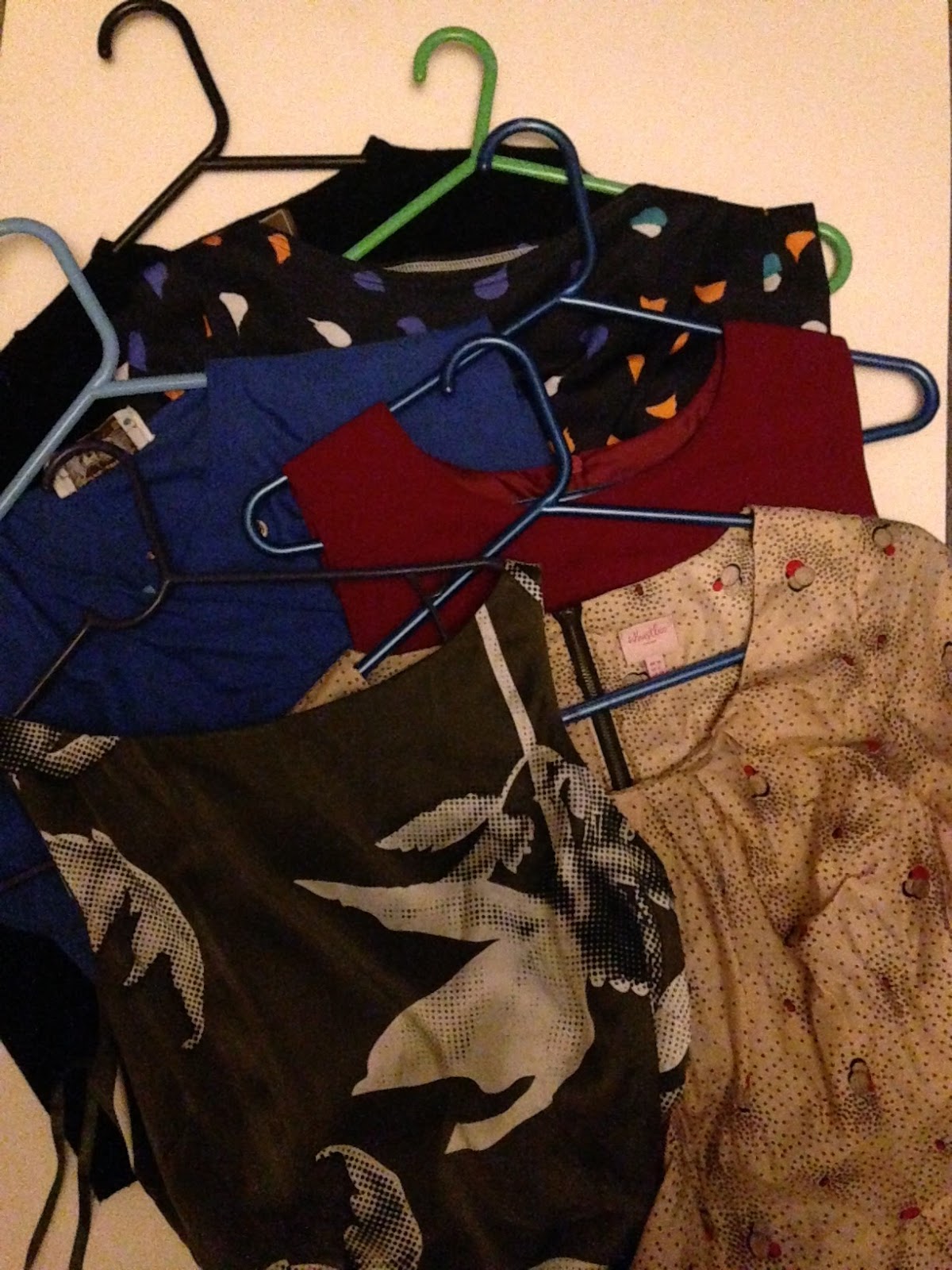
My Fashion Fast- the Six Items Challenge

Starting on the morning of Wenesday 1st March, I will be taking part in  Labour Behind the Label's 6 Items Challenge. The charity supports the rights of garment workers all over the world, who are often exploited or placed in danger while working long hours to make the clothes we take for granted. 

Until Easter, my wardrobe will only consist of six 'key' items (I'll be allowed to change my underwear, socks and shoes, I'm sure you'll all be relieved to hear!), and I've deliberately picked items that I didn't buy brand new. 


My wardrobe for the next six weeks! 

I buy most of my clothes from vintage or charity shops now, but because it's harder to buy an intentionally matching or complementary capsule wardrobe when you don't know what clothes are going to be available, it's easy to see these shops merely as sources of 'novelty' options to add a bit of colour or quirkiness to our 'everyday' wardrobes. I'm lucky that I don't have a dress code to follow at work, and that I have a large existing wardrobe of clothes to draw on, but hopefully the pictures from my 40 day challenge will show that second hand clothes can be versatile, hard wearing and appropriate for every occasion! 

I'm sure some of you probably don't see much difference between this 'challenge' and your existing wardrobe. Others may be wondering if it's not just a reason to post a bunch of selfies and feel smug afterwards, even though I haven't actually 'done' anything physical or arduous. I took this challenge three years ago and I found it drastically altered by clothes-buying habits; all the clothes I have bought since have been purchased with this challenge in mind. Do I love something enough to wear it over and over again? Is it comfortable enough or well enough suited to my lifestyle that I could keep wearing it even if I'm a bit bored of the style or colour? 

But really that's a side benefit of the challenge for me, I'm really doing it for all the women who have the same skill set as me, but whose work is so undervalued as to be seen as disposable by so many of us. During the six weeks I'm participating in the challenge I'll be posting some tips I've picked up from my years working in costume making and wardrobe that we can all use to keep our clothes looking their best for longer. 

Over the next five days you'll be able to 'meet' my new capsule wardrobe (five dresses and one cardi; I'm currently packing away everything except my scarves and tights!) and donate to a very worthy cause over on my Everyday Hero page .

Wednesday, 18 January 2017

Starting my personal fashion revolution

My dissatisfaction with ‘fast fashion’ began several years ago, but I hadn’t thought to blog about it because I didn’t think I was doing anything special or noteworthy, and I certainly don’t have the perfect ecologically sound, sustainably sourced wardrobe. I wanted to make more positive, thoughtful choices, but the more I read about the problems with the fashion industry (waste, pollution, destruction of the environment, exploitation of garment workers, the list goes on…), the more I began to wonder how my personal buying habits could possibly affect such a vast global industry. I worried that even making ‘good’ purchases could be full of hidden pitfalls- would organically sourced cotton clothing be made by workers who were paid a fair wage? If I buy from the ‘Eco' range of a fast fashion retailer have I just been hoodwinked by their marketing? Tansy Hoskins, the author of ‘Stitched Up- the anti-capitalist book of fashion’ describes this as ‘ethical calculus’ and argues that it doesn’t address the underlying problem of overconsumption.

It seemed like there was no perfect solution, and I have definitely been part of the problem: for years I was one of those people who viewed shopping as a hobby, and bought far more clothes than I really needed. In fact, I owned so many clothes that I didn’t really wear most of them all that often, and I was washing items carefully and mending things I really liked, so nothing was wearing out. With my clothes storage at bursting point, and new financial responsibilities to take into consideration, something had to give.

I don’t think I made a deliberate decision to scale down my clothes purchasing, I just stopped enjoying a certain kind of shopping. I’d browse ‘must have’ lists in magazines and do some window shopping, but fast fashion had suddenly become uninspiring. By contrast, finding something unique and unusual in a charity shop or vintage market felt fun and exciting, and removed the stress and inevitable disappointment I’d sometimes feel trying to track down a particular trend on the high street.

Taking part in Labour Behind the Label's Six Items Challenge in 2014 was a big turning point for me, as it made me really think about what makes a piece of clothing a ‘must have’ item for me, and how important it is to appreciate and care for the clothes I already have. As a dressmaker myself, I thought about the disrespect I had shown to my fellow garment workers (working harder, faster and in far more dangerous conditions than I would ever be forced to) by viewing the clothes they made as disposable, while I expected the things I made to be cherished and valued.


Finding different ways to rock a jumpsuit during my Six Items Challenge made me realise how much I'd undervalued my accessories in the past! 


My focus for my wardrobe this year is to make sure I am enjoying my extensive clothing collection to its full potential- altering things to fit better, mending things before they wear out beyond repair, washing and storing everything carefully. As and when things wear out, I’ll think carefully about how best to replace them, and how to recycle or responsibly give away items I no longer use.