Monday, 4 October 2021

Wandle Trail: walking and stitching

 To mark the one year anniversary of the start of my Wandle Wardrobe project, I spent a weekend trying out a mini-project; I walked the Wandle Trail from the Thames at Wandsworth back to the source in Carshalton on Saturday, and then from Wilderness Island (where the river divides) to the source in Croydon on Sunday, stitching a map of the river.


I pre-stitched the river itself to give me a guideline, packed up a box of embroidery threads, needles and scissors, and arrived at The Spit, where the Wandle flows into the Thames, at 10am on a beautiful sunny morning. I didn’t have a definite plan for what the finished work should look like, but I was aware that whatever I was stitching in each location needed to be quick and basic. I wouldn’t have time to make a detailed study of the beautiful old tree I was sitting under, but I could acknowledge its existence with a French knot in a deep forest green. The fancy new-build apartments with their Thames view were condensed down to a few straight stitches in several different threads, echoing the architect’s colour scheme.


Wandsworth is very much a manmade landscape - industrial sites (grey), the Ram Quarter (sandstone brick), the Southside Shopping Centre (concrete) and King George’s Park (sports fields, neatly manicured). Sitting down on a bench in the park to stitch, I felt like I was getting into a rhythm of how I wanted to represent certain structures, almost like creating a key for a map. 


Through Earlsfield, the walking route detours from the Wandle itself, down several streets of neat Victorian terraced houses and past a High Street of cafes and shops before returning to the river along an exuberantly overgrown bank, with tantalising glimpses of the allotments on the other side. I picked a terracotta and a putty-coloured thread to suggest the red-brick houses with their ornate plaster detailing. I used the pattern of stitches to illustrate the different types of plant growth I could see - neat squares for the allotments, an uneven, overlapping straight stitch for the creepers creating a blanket of green over the bank. 


Heading towards the more wild stretches of the Wandle, I started to concentrate more on the colours of the foliage I was passing, taking time at my next sewing stop to select a bluish-grey for Willow, a deep green for a tangle of ivy, yellow ochre for the dry grasses and seed heads that covered Wandle Meadow Nature Park. After walking the Wandle so many times focussing on spotting small things; either lost clothes or textile waste along the path, or specific birds or insects, it was a very different experience to focus on what the area looked like as a whole, getting a general impression of colour and texture, and then trying to express this impression through a few stitches. 


Stopping for lunch at Merton Abbey Mills, and in the Rose Garden at Morden Hall Park gave me the opportunity to stitch at two of my favourite locations along the trail (Merton Abbey Mills is the last physical reminder of the Wandle’s importance as a site of textile production, and who doesn’t love a pub lunch overlooking the river?) before I was on to the part of the trail I know best, through Ravensbury Park, Watermeads Nature Reserve and past Poulter Park. Recording my surroundings here was all about noticing the combinations of the natural and the man-made along the river - the houses secluded behind centuries-old plane trees, the industrial units shrouded from view by weeping willows. 


My penultimate stop was in the Hackbridge community garden, lovingly curated by Claudio Funari who collects fly-tipped furniture and bric-a-brac and transforms it into whimsical sculptures and seating for his colourfully-planted garden. It felt like an appropriate place to stitch my local area, a patchwork of new-build houses, older estates, deliberate green spaces and scraps of no-man’s land that have turned into wonderful wildlife habitats.


I couldn’t linger long as I was conscious of dusk fast approaching, so I walked the final familiar stretch of this branch of the Wandle to Carshalton, and sat near Carshalton Ponds, looking across to Honeywood Museum, where the river flows from a spring in the garden under the building itself - a very fitting location for my first Wandle Wardrobe exhibition and the perfect place to finish a long day of walking and stitching.
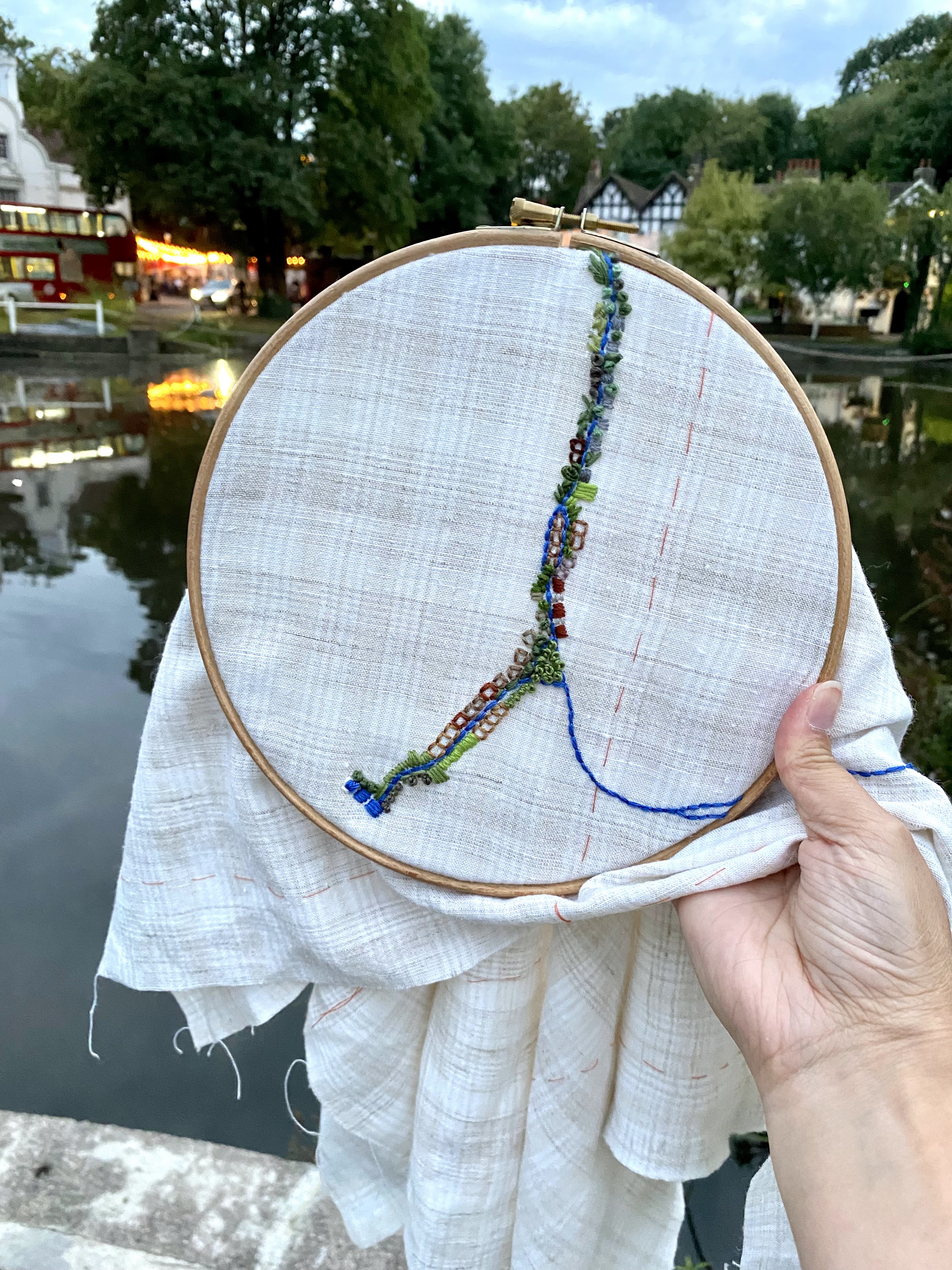


I resumed the walk on Sunday morning from Wilderness Island, and my first stitching stop was Beddington Park, where I was easily distracted by a number of good dogs playing in the river, and lovely people coming to chat to me about sewing. Walking on through a series of small parks and residential streets, I became quite particular about the thread colours I was using to denote each type of housing - victorian and edwardian terraces, a 1930s cul-de-sac, several different estates of modern housing with distinct building materials and textures. 


Stopping to stitch in Waddon Ponds I was almost overwhelmed with nature after my walk along suburban streets - Canada geese patrolled the footpath while seagulls stole food from one another and rats scurried in and out of the reeds. The blue-grey of the willows matched the rapidly greying sky, and I started to feel moisture in the air, so I hurried on to Wandle Park in Croydon.


The start of the Wandle in Croydon - a grated concrete drain covered in graffiti - seems like an inauspicious start to a river that has become such a haven for wildlife, but the water flows out into a flourishing reed bed, and the horse-chestnut trees were just starting to turn autumnal shades, sending squirrels scurrying to look for conkers. As I finished my final stitch, I felt the first drop of rain, and I packed up and scurried to the nearest tram stop before the weather really took a turn for the worse.


I made the stitched map into a top (with the back made from a different piece of Wandle fabric), and I’m pleased that I can look at it and identify individual areas - it might not work as a conventional map but it makes sense to me! I’m keen to try more walking and stitching, perhaps changing my focus to a different aspect of the Wandle Trail, or going on a different walk entirely. I feel like I’ve just scratched the surface of this way of stitching something immediate and unplanned, and I’d like to take it further, make it more expressive and emotional.


Thursday, 30 September 2021

The Wandle Wardrobe: One Year On

 When I started the Wandle Wardrobe project in September 2020, it was only meant to take a week. Three days to walk the Wandle Trail, three days to create my original two Wandle quilts, and then a day displaying them on the communal field as part of a local art exhibition. I didn’t expect to find enough vintage fabric to make a whole new wardrobe of outfits, or to spend five of the next seven months in lockdown, with my only permitted leisure activity once again being the local walk. 


Continuing with the Wandle Wardrobe gave those walks a purpose, and gave me a reason to go outside as often as possible during the winter months when I might otherwise have stayed indoors. The items I found changed with the seasons - a decrease in the number of lost gloves as sure a sign of the approach of spring as the new leaves on the trees. Although I didn’t have a specific end date in mind, the project drew to a natural conclusion in April when restrictions started to lift and I was able to travel further afield and meet up with friends again. The Wandle Wardrobe clothing project will carry on until I run out of fabric, which won’t be for the next year or so! 


Lockdown restrictions meant that I didn’t walk further north than Colliers Wood, so the project became slightly more localised, but I still recorded all my finds in the same way - photographing them in situ, before taking them home to be cleaned. The near-constant rain during the winter meant that most of the larger items of clothing I found were beyond saving; heavily mildewed, if not entirely waterlogged. I did find a prom dress and corset that were clean and dry; they eventually found their way to a clothes swap. I’ll always wonder what dating disaster led to these pricey pieces of clothing being hurled into some bushes. 


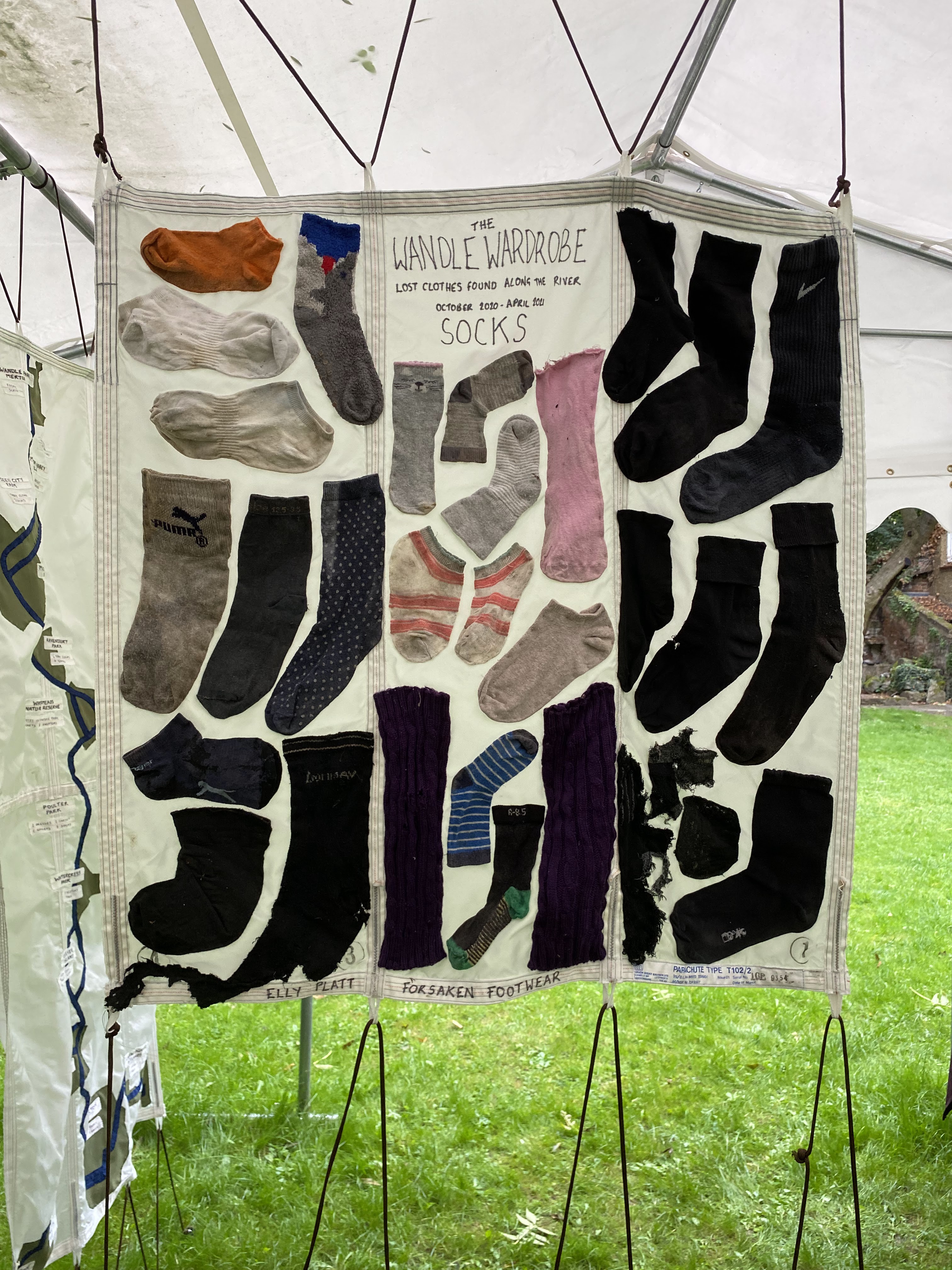
The categories I’d divided my finds into for the first quilt - gloves and socks, and accessories and scraps - divided neatly again into four categories for my second series of quilts, but I realised that I wanted a more permanent (and portable) record of where and what was found than the original twenty-metre fabric representation of the Wandle with its attached Polaroids. I made a double-length quilt with an appliquéd Wandle and its surrounding green spaces from Colliers Wood to Carshalton and Croydon (using fabric I’d found at Watermeads nature reserve), along with a list of found items and the locations of some of the most surprising or plentiful finds.


I also wanted to provide some context since the project had now become something I could exhibit without being present. For the project to have meaning for a wider audience, I included a very brief biography of the Wandle, and description of the project, along with the questions I wanted viewers to consider. I hope that the Wandle Wardrobe will encourage conversations about how we treat our clothes and our green spaces in an entertaining and accessible way. 


I’ve loved talking to people about the project and hearing their interpretations of my work - I had some excellent chats while I was stitching two of the quilts in the gardens of Honeywood Museum as part of the Carshalton Artists summer fair. Lots of older people talked about how different their experiences of owning and caring for clothes have been, compared to today’s throwaway culture. One question came up a lot - “what if someone sees one of your quilts and says “that’s mine!”?” I would honestly love it if that happened - I’d happily cut off their item and give it back to them! Although I might want to stitch round it first so it leaves some sort of ghostly impression. I really enjoy how these conversations open up new thoughts and possibilities for me too, creating a dialogue through our lost clothes.


In between washing and cleaning my finds, deciding on the design of each quilt, stitching down several hundred pieces of lost textile, cataloguing where I found what, and working out exhibition logistics, I haven’t had much opportunity to reflect on a year-long project. So last weekend I walked the Wandle again, in the opposite direction (from the Thames to the sources) to create a small piece of textile art as I walked, and to spend some time with my thoughts and enjoy the beauty of my local green spaces. I’ll be writing about this in a separate post, but it reminded me that you can look at an area in broad strokes or minute detail. The more you notice, the more you notice what’s wrong (the litter) as well as what’s right (the variety of bird and insect species). Focusing solely on what’s wrong is emotionally draining, so it’s important to allocate time to appreciate the good things around too, and sometimes it’s nice to reset your perception of your local area by just walking with a very different purpose and seeing what you notice instead. 


Saturday, 12 June 2021

London National Park City Rangers - making London greener, healthier and wilder


At the start of the year, when the only thing getting me out of the house on cold and rainy weekend days was my Wandle Wardrobe lost clothes project (“think of the muddy socks and old gloves you can pick up if you go out for a walk during this 6-hour window of daylight!”), I saw a tweet about London National Park City, and found out that they were recruiting for new Rangers. Being out in nature was pretty much the only thing enabling me to cope with the stress of an ongoing global pandemic, and I wanted everyone to have access to that source of beauty, wonder and resilience.


London National Park City’s mission is to make London greener, healthier and wilder. Having a network of Rangers across all London boroughs means that LNPC can share knowledge and resources, champion local projects and get people of all ages participating in activities like growing food, guerrilla gardening and learning about nature. London has large, impressive green spaces that everyone knows about, like Hyde Park and Hampstead Heath, but smaller, local spaces like community gardens, allotments and patches of no-man’s land are also vital resources, both as habitats for wildlife and as places where people can get closer to the natural world.


LNPC has recruited 110 Rangers over the past two years (including me!) with an impressive and diverse range of skills. Wildlife experts, foragers, community organisers, teachers, educators, gardeners, artists, storytellers… all ready to share their love and enthusiasm for London’s green spaces.


The link between fashion and being “greener, healthier and wilder” might not be immediately obvious, but fashion has a huge environmental impact, and is also a powerful resource for visual storytelling. Our current overconsumption of clothes, and some people’s habit of discarding them after only a few wears, means that clothing is now a source of rubbish, just like single-use plastic. Indeed, over 50% of clothing is made from polyester, which means it IS plastic, and will shed microfibres into any water source it ends up in. It will also take hundreds of years to decompose. It is vital that we start taking better care of our clothes to minimise the amount that end up in landfill.


Presenting my Wandle Wardrobe finds on “quilts” as though they were precious heirlooms rather than scraps of discarded clothing will hopefully help some people to rethink their attitudes about the clothes they own. My “Rainbow Remnants” quilt will be on display at Honeywood Museum as part of the Carshalton Artists Open Streets Exhibition from 17th June to 25th July.


I am by no means an expert on London’s extensive flora and fauna, so I’ve set myself a challenge to improve my ability to identify wild flowers and plants this year. I am taking part in wildflower surveys for Verging On The Wild Side, a Sutton-based group gathering evidence in the hope of persuading local authorities to allow roadside verges to be left as wildflower habitats rather than sad strips of scorched grass. I spent rainy weekends in May researching London’s plant life, and creating my own florilegium in fabric form, consisting only of roadside “weeds” to emphasise what beautiful and interesting plants they are! This is currently an ongoing project, but expect a blog post about it soon.


Now that pandemic restrictions have eased a bit and the weather is perfect for spending long weekend days outdoors, I’m really enjoying volunteering again; helping out at the Carshalton Lavender farm and going on local litter picks. I’m looking forward to meeting my fellow Rangers outside in our natural habitat, and dreaming up projects to get plenty more people feeling as enthusiastic about London’s green spaces as we do!


The pictures that illustrate this blog post are close-ups of the scarf I embroidered as part of my LNPC Ranger application. I love the idea of London becoming as well-known for its green spaces and wildlife diversity as it is for its historic buildings and monuments. Everywhere the two can coexist makes London a healthier and more pleasant place to live and work.


Sunday, 4 April 2021

The Wandle Wardrobe: Greenfinch Dress

 Seeing a greenfinch in a patch of no-man’s land near my flat in March 2020 marked a turning point in the way I thought about London wildlife. The last year has dramatically changed my relationship with London, and alongside forming strong relationships with my neighbours, I’ve also become better acquainted with many of the non-human residents of my neighbourhood. 


Growing up in a small town in West Sussex, weekends were often spent on country walks with family and friends, learning the names of trees, flowers, birds and insects. Certain walks became favourites, and they marked the passing of the seasons. Snowdrops, wild daffodils and bluebells in the woods during spring. An evening walk on the common to listen to nightjars and look for glow worms at midsummer. Kicking through drifts of golden leaves collecting sweet chestnuts and conkers in autumn. A blustery walk on a beach with geese flying overhead and a flask of hot soup in the car in winter. When I moved to London at eighteen, I still wanted to make these nostalgic pilgrimages back to Sussex every year, creating small family rituals around these much-loved pockets of natural beauty.


I had sought out green space in London, of course, but for years none of the places I walked or picnicked took on the same significance - when you and your friends are renting and always moving, nowhere stays local for very long. During the last decade I’ve only moved twice, and I began to develop a fondness for the Wandle - I found solace walking its scrubby banks when my mind was in turmoil from anxiety and depression, and it began to reward me with glimpses of its riches. I would often text my parents with bird sightings and news. But I still returned to Sussex, treasuring our beloved walks as a balm for my soul, and all-important time with my family. 


When the nationwide lockdown was announced last year and I realised that I wouldn’t be marking spring with my usual excursions, my local hour-long walks became more intentional. I took my binoculars, I photographed wild flowers, I made a list of the birds I saw. I was well aware that London wildlife was far more varied than the stereotypical feral pigeons and urban foxes, but I had never thought of a greenfinch as a “London bird”. And yet here they were, in numbers, a fifteen minute walk from my flat. 


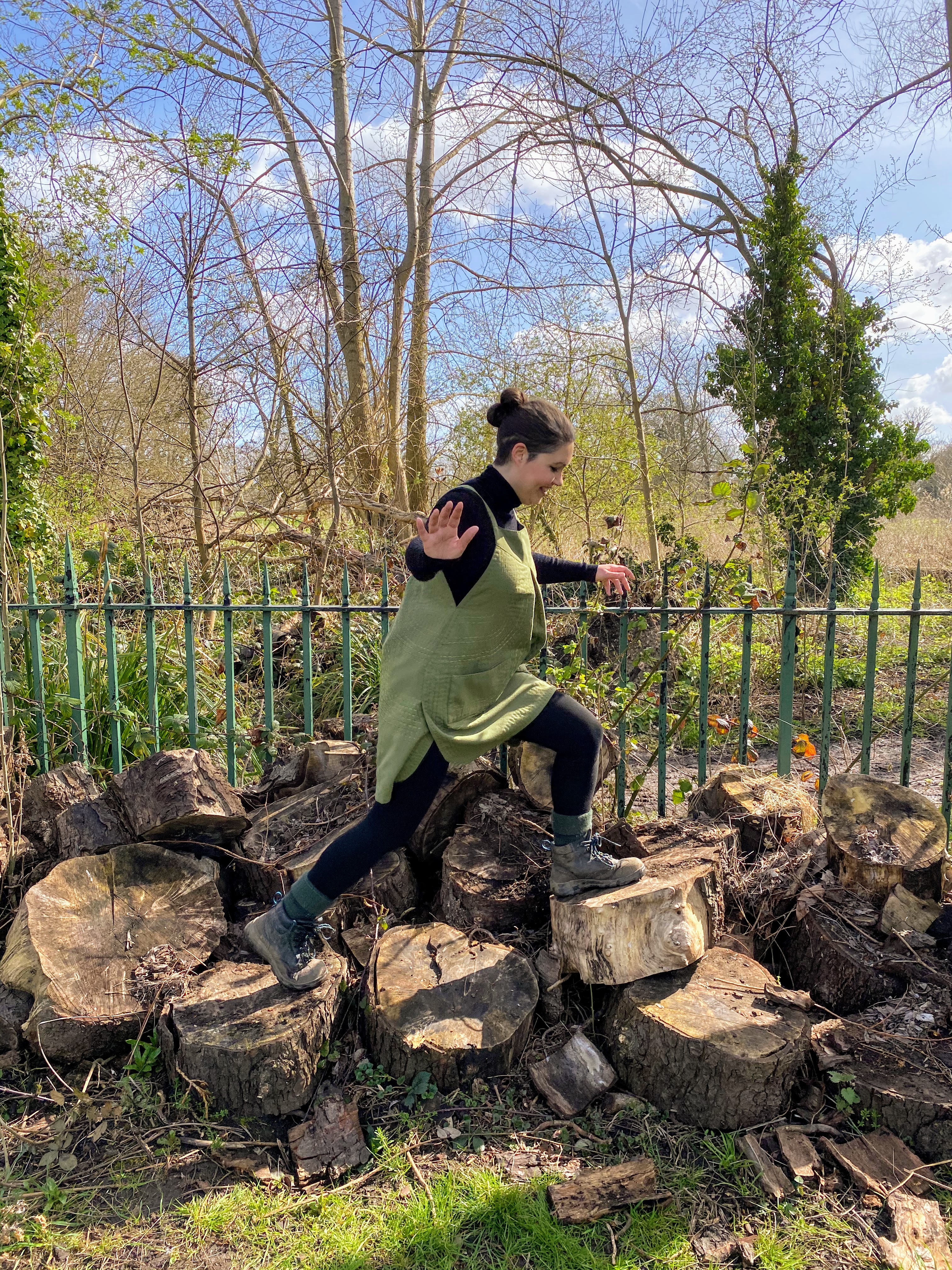
The Greenfinch Dress is made from three metres of a woollen mix fabric I found dumped near the Wandle back in September. Necessity being the mother of invention, I made the dress I wanted to wear during months of lockdown winter walks. I don’t find trousers warm enough for winter, I prefer to walk in cosy layers - leggings, long socks, leg warmers, a wool skirt. In her book Wild Dress, Kate Fletcher devotes a chapter to walking in skirts. She emphasises the importance of knowing your ideal hem circumference -  “a stride and a bit”. Wading through suddenly-flooded parks this winter, leaping over newly-formed streams that threatened to overtop my boots, I took her advice. A stretchy knitted skirt gave me freedom of movement, but was sadly lacking in pockets, and didn’t provide quite enough insulation when I sat down. The loose A-line shape of the dress allows for plenty of movement, as well as the wearing of several layers underneath. The double layer of fabric provides warmth, and a canvas for some mindful embroidery during the darker months. 


I’ve marked a year of changing seasons through local walks in London now, and been delighted by the wild beauty I’ve found. Although I’m looking forward to walking further afield, I’ve found so much to interest me close to home, and I’ll continue to appreciate that .


Tuesday, 16 March 2021

The Corvid Dress: Grief and the anniversary of a pandemic

 This time last year, I took my first local morning walk instead of my regular commute by train into central London. The sun was shining, although there was still a chill in the air, and the path was lined with flowers - violets, celandines, dandelions. I took photos of the blackthorn blossom and pussy willow. It was a rare moment that week when I didn’t feel distracted by uncertainty, worry, or the need to constantly check my phone for news. A week later, a total lockdown of the UK would be announced, and I would be furloughed for six months. A year later, here we are again, still in lockdown, tentatively looking for signs of spring, but with that loaded reminder of what it signalled in 2020, and all that we have lost over the last twelve months. 


Like many people, I have found solace in nature during the pandemic, and I’ve discovered a remarkable variety of wildlife in my small corner of London. I’ve counted over fifty different bird species, letting their songs and calls soundtrack my walks in order to immerse myself more fully in their world. I have contemplated the positive things their presence says about the quality of water in our local river, the amount of available food in patches of no-man’s land. I wish I was writing a positive post today. 


Experiencing bereavement in a year where over 130000 people have died in the UK as a result of the pandemic isn’t unusual or, sadly, unexpected. But experiencing two bereavements in as many days, during a lockdown where I am not allowed to hug, or indeed physically see friends who are suffering this grief more acutely than I am, feels unbearable. We are forced to grieve everything privately, touch-starved, confined to our Zoom window. 


As I was writing this post and making this dress, I’ve witnessed public displays of grief being violently suppressed in London. I’ve struggled to manage my private sadness for personal losses alongside the public outpouring of rage and anguish over the murder of a young woman, and the systemic violence that led to her death. How do we mourn, when a public act of mourning is now a crime?


As someone who studies the history of fashion, and as a former teenage goth, I have always been fascinated by Victorian mourning customs. While unsurprisingly I’m not wild about the compulsory or restrictive aspects of mourning dress (and grief is physically painful enough as it is without having to wear uncomfortable, scratchy fabrics), being able to show the world you are grieving through your clothing (if that would be helpful to you) feels like a powerful thing. Our online presence is often edited to show only the positive, photogenic parts of our lives (which I honestly don’t mind - no one is required to share the sad or difficult things they’d rather keep private), but a visual shorthand for “I am feeling many terrible emotions which I am struggling to put into words” might be helpful, even necessary, as people come to terms with the terrible toll that the last year has taken on our mental health, and our need to grieve as a nation. Keeping a stiff upper lip and pretending the whole thing wasn’t that bad really is a terrible way to deal with our emotions. 


Corvids, and crows especially, are associated with death in many different folklore traditions. But in recent years they have captured our imaginations again as scientists reveal the extent of their intelligence. Corvids can recognise individual humans, and assess whether these humans are treating them fairly. They are able to hold grudges against humans that treat them badly, and even pass this information to other birds. If a corvid dies, others will gather around to assess any potential threat so they can avoid it in the future. 


I understand the desire, even the desperation, to go “back to normal” as soon as restrictions are lifted and put the horrible memories of the pandemic behind us. But trying to ignore or suppress this collective grief will be terrible for our mental health in the long run. We need time to grieve in whatever way feels appropriate to us, and we also need to remember. Not only those who died, but the reason why. The mismanagement of the pandemic that led to so many deaths, the dire warnings from scientists that were ignored time and time again, the corruption that wasted billions of pounds and left frontline workers at risk. Holding grudges may not be productive, but we need to hold the people in power to account. I agree with and abide by current Covid restrictions, but I am furious at the government’s inability to learn from its mistakes, and the way it regards certain sections of the population as acceptable collateral damage.


The Corvid Dress was made from two and a half metres of pre-pleated black viscose, from my haul of vintage fabrics found near Watermeads Nature Reserve, and part of my ongoing Wandle Wardrobe project. The simple shape of the dress (a zero-waste rectangle gathered with drawstrings and elastic) is similar to several of my favourite 80s dresses; they are very easy and comfortable to wear. Rather than meeting in formal settings to pay our respects to those we’ve lost, memorial meet-ups are likely to be informal events in parks for the next few months at least. Clothes for these events will need to have an element of practicality. I’ll be wearing this dress as soon as I can meet up with a certain group of friends - a reunion that will sadly be a time to mourn those who won’t be joining us. My thoughts are with everyone else who will also be experiencing these bittersweet meetings in the weeks and months to come. I hope you find a way to remember your loved ones and celebrate their lives, and to feel and express your grief with the support of your community. 


Sunday, 17 January 2021

The Wandle Wardrobe - Robin lounge suit


Winter can be a difficult time of year for some of us. The short days, low light levels and cold or rainy weather can leave us feeling lethargic, or even depressed, and this winter is turning out to be more difficult than most. As the covid pandemic reaches its second peak, all the things that would usually bring us joy during the long hours of darkness have suddenly become dangerous, both to ourselves and our loved ones. No cosy afternoons drinking hot, sweet beverages in cafes, or evenings around a log fire in the pub. No visits to see friends or relatives, no opportunities to sprawl on their sofas eating leftover cake and mince pies. The glitter all but disappeared from the festive season, as parties were no longer in-person events, the sparkle of a sequin barely visible in the tiny rectangles of a zoom call.


For those of us who turned to the outside world to get us through the first lockdown, the winter presents a new set of challenges. Richard Adams sums it up well in his famous novel Watership Down: “Many human beings say that they enjoy the winter, but what they really enjoy is feeling proof against it.” There are months still to go until we start to see the blossom and new leaves that delighted so many of us on our initial lockdown walks in spring last year. When we venture out of our houses in mid-January, bundled up against the cold, we’re likely to see bare branches against a grey sky, and mud. So much mud. With the last of the autumn’s crop of berries being devoured by hungry birds, a winter landscape can seem devoid of colour.


With all this in mind, it’s not surprising that Britain’s favourite bird is the robin. When you hear a burst of birdsong, and see a flash of the robin’s red breast, a dormant landscape is brought suddenly to life. Robins have graced festive greetings cards for over a century, and have inspired numerous Yuletide decorations. It’s a bird many of us can recognise, and most of us will get to see, even if we live in urban areas. Leaving my house before dawn on some of the shortest days of the year and hearing a robin singing in the darkness feels like a little spark of magic, putting a spring in my step and making me aware of my surroundings in a way that feels full of possibility. Nevermind that it’s the same old street, the same old seven minutes to the station. If I’ve heard such a beautiful song, what else might I hear? Or see?


With the robin as my quintessential Winter Bird, the piece of clothing I wanted to make was something quintessentially Winter 2020/21. Something that would add a splash of colour to long dreary locked-down days, something comfy and cosy that would also have an element of fun to it, that would make me want to get up and get dressed, even if what I was putting on was a fancier version of my pre-existing pyjamas.


The Robin lounge suit was made from two and a half metres of brushed cotton, dark red with a blue and green floral print, from my found fabrics stash. The wide leg trousers have an elasticated waist (perfect for solitary winter feasts) but are inspired by 1930s palazzo pants - designed for looking glamourous while relaxing of an afternoon. The matching top has a voluminous hood, inspired by binge-watching costume dramas (ideal for keeping really snug when snow is forecast), and sleeves that suggest a desire to maintain social distancing at all times. I liked the idea of the proportions of the outfit being slightly absurd; for all I’ve waxed lyrical about the beauty of the robin’s song, it’s either a threat or a dating profile if you’re another robin. I enjoy that sense of strangeness when I am interpreting the natural world into a man-made creation; the idea that something might have got lost in translation. For the Robin lounge suit, I’ve combined elements of elegant leisurewear and essential winter clothing from the past with clashing modern colours and an exaggerated silhouette to recreate that winter lockdown essential - the tracksuit - with a twist.


This winter might feel like a time where our plans, our hopes, our dreams, are once again lying as dormant as the natural world outside. But we can ignite a sense of hope through something as simple as wearing something that feels good and makes us smile.